
Quick answer: An AI insulin pump is a closed loop system made of an insulin pump, a continuous glucose monitor (CGM) and a dosing algorithm. The CGM reads your glucose about every five minutes, the algorithm predicts where it is heading, and the pump raises, lowers or pauses insulin on its own. In India, the MiniMed 780G is the system with an official launch for type 1 diabetes. It costs about Rs. 6.49 lakh for the pump plus roughly Rs. 16,400 a month for sensors and supplies.[1][5]
If you searched for an AI insulin pump, you probably want three answers: what it actually is, whether you can get one in India, and what it will cost you. This guide covers all three in one place, so you do not have to piece the story together from ten different websites. If you are still trying to understand whether your symptoms point to diabetes at all, start with our guide on signs of diabetes.
What is an AI insulin pump?
An AI insulin pump is not a separate gadget with a mind of its own. It is an insulin pump that talks to a continuous glucose monitor (CGM), a small sensor worn on the body, and uses software to decide how much insulin to deliver next. Doctors call this an automated insulin delivery (AID) system, a hybrid closed loop or, informally, an artificial pancreas.
The AI label needs one correction. These systems do not learn your habits the way a chatbot does, and they do not make decisions outside a narrow, tested job. The software is a dosing algorithm that has been studied in clinical trials and approved as a medical device. Some systems adapt parts of their dosing as they see more of your data, but all of them work inside safety limits set by the manufacturer and your doctor. Think of it as a very attentive assistant with one task: keeping your glucose inside a target range.
How does an AI insulin pump work?
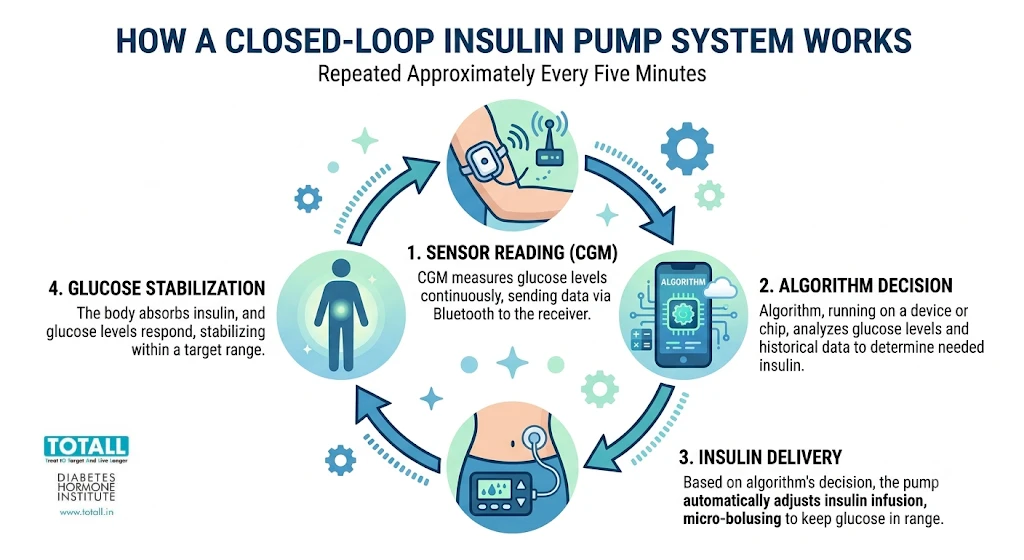
Every closed loop system has three working parts, and one human who stays involved.
- The sensor (CGM) measures glucose in the fluid under your skin and sends a new reading about every five minutes.
- The algorithm looks at the current reading and the direction your glucose is moving, then predicts where it is heading.
- The pump raises, lowers or pauses your background (basal) insulin. Advanced systems such as the MiniMed 780G can also give small automatic correction doses when glucose is climbing.[1]
- You still announce meals by entering carbohydrates or using meal presets, and you change the infusion set and sensor on schedule.
That last step is why current systems are called hybrid closed loop. A fully automatic system that needs no meal input is still in clinical research and is not yet standard care.
Levels of automation
| Level | What the system does | Example |
|---|---|---|
| Standard pump (open loop) | Delivers insulin you program. No automatic changes. | Older pumps without CGM link |
| Low glucose suspend | Pauses insulin when the sensor shows a low or predicts one. | First generation sensor augmented pumps |
| Hybrid closed loop | Adjusts basal insulin automatically. You announce meals. | Tandem Control-IQ, Omnipod 5 (sold abroad) |
| Advanced hybrid closed loop | Adjusts basal and gives automatic correction doses. You still announce meals. | MiniMed 780G (available in India) |
| Fully closed loop | Handles meals as well, with no announcement. | Still in research, not standard care |
AI insulin pump vs regular pump vs injections
| Feature | Insulin injections | Regular insulin pump | AI (closed loop) pump |
|---|---|---|---|
| Who adjusts insulin through the day | You | You | The algorithm, within set limits |
| Needs a CGM | Optional | Optional | Yes, for automatic mode |
| Automatic correction doses | No | No | Yes, on advanced systems |
| Protection from lows | Depends on you | Depends on you | Insulin is reduced or paused automatically |
| Daily effort | Several injections | Set changes plus manual dosing | Set and sensor changes, meal entry |
| Cost in India | Lowest | High | Highest |
What does the evidence say?
The aim of automated insulin delivery is more time in range, which is the share of the day your glucose stays between 70 and 180 mg/dL. International consensus sets a target of more than 70% time in range for most adults with type 1 diabetes.[6]
In a real-world study of 213 adults with type 1 diabetes, all three AI insulin pump systems tested improved time in range. After adjustment, people using the Medtronic 780G gained about 21 percentage points, compared with about 10 points on Tandem Control-IQ and about 15 points on Omnipod 5.[3] This was an observational study, not a head to head trial, and people started from different baselines, so read the gap as a signal and not a verdict.
What matters most for you is rarely which brand tops a chart. It is whether you can wear the sensor reliably, keep up with set changes, and reach a team that can adjust your settings.
Is an AI insulin pump available in India?
Yes, but the choice is narrower than in the United States or Europe.
MiniMed 780G: the officially launched option
Medtronic launched the MiniMed 780G in India in March 2022 as the first advanced hybrid closed loop pump in the country. The system automates basal insulin and correction doses every five minutes, and lets you set a glucose target as low as 100 mg/dL.[1] It works with Medtronic’s Guardian 4 sensor, which is worn on the arm.[2]
Other systems you may read about
Omnipod 5, the Tandem t:slim X2 with Control-IQ and the Beta Bionics iLet are discussed widely online. Insulet’s own website has stated that Omnipod is not available in India,[4] and as of October 2026 we could not find an official India launch for the Tandem or iLet systems. You will see them on online marketplaces, usually as imported units from resellers. These listings often mix pumps, single pods and old stock, which is why prices online swing from a few thousand rupees to more than six lakh. An Indian made tubeless patch pump called InsuPatch was announced by Renu MedTech in late 2025, but we have not confirmed that an automated version is on sale.[4]
Do-it-yourself loop systems
Open source loop apps exist in the diabetes community. They are not approved medical devices, and we do not recommend them outside close specialist supervision.
AI insulin pump price in India
These are the figures we could verify for the one AI insulin pump system with an official India launch.
| Item | Approximate cost | What to know |
|---|---|---|
| MiniMed 780G pump with starter kit | Rs. 6.49 lakh, one time | Quoted by an Indian clinic in September 2026[5] |
| Guardian 4 sensors | Rs. 13,880 for a pack of 5, about Rs. 12,100 a month | Each sensor lasts 7 days[5] |
| Infusion sets | Rs. 4,080 for 10, about Rs. 3,100 a month | Changed about every 4 days[5] |
| Reservoirs | Rs. 1,570 for 10, about Rs. 1,200 a month | Changed with each set[5] |
| Monthly consumables | About Rs. 16,400 | Insulin, batteries and test strips are extra |
| GST | 5% | Reduced on 22 September 2025[5] |
| Warranty | 4 years on the pump, 1 year on the transmitter | Sensors and accessories excluded[5] |
Add it up and the first year costs about Rs. 8.5 lakh: Rs. 6.49 lakh for the pump plus twelve months of consumables at Rs. 16,400. From the second year, running costs are close to Rs. 2 lakh a year if prices hold. Some people on an AI insulin pump need less insulin and fewer test strips, which offsets part of the cost, but how much varies from person to person.
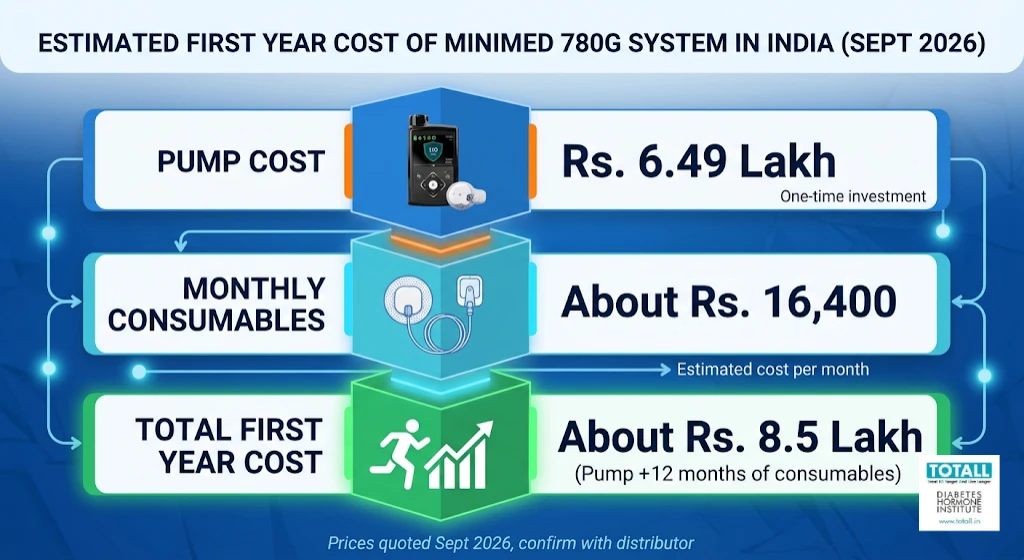
Two cautions about these numbers. Medtronic India does not publish a list price, so the pump figure is what one Indian diabetologist’s clinic quoted, not an official MRP. And prices change, so ask the authorised distributor for a written, itemised quotation with GST shown before you pay.[5]
Does insurance cover an AI insulin pump?
Health insurance in India generally does not pay for an insulin pump, because most policies cover hospital admission and a pump is an outpatient device. Ask your insurer in writing. Zero interest EMI schemes have been offered by the manufacturer in the past and distributors commonly arrange credit card EMI, but terms change, so confirm what is live on the day you buy.[5] We are not aware of a national scheme that pays for pumps.
Is a CGM alone a smarter first step?
For many people, yes. A CGM shows your patterns and helps prevent dangerous highs and lows at a fraction of the cost of a full pump system.[5] If your sensor data show frequent lows or large swings despite good injection habits, that is a strong reason to discuss an AI insulin pump with your doctor.
Who should consider an AI insulin pump?
An AI insulin pump tends to suit people who:
- have type 1 diabetes, including children from age 7 and teenagers, and want fewer injections and fewer lows
- have unpredictable glucose despite careful injections
- are willing to wear a sensor and an infusion set all the time and to learn carbohydrate counting
- can afford the monthly consumables for years, not only the first purchase
- have a diabetes team that can train them and adjust settings
It may be better to wait, or start with a CGM alone, if you cannot sustain the monthly cost, cannot attend follow up, or find wearing devices on the body difficult. People with type 2 diabetes need a specialist assessment, because the India launch was for type 1.[1] In the United States, the FDA extended the MiniMed 780G label to adults with type 2 diabetes in August 2025.[7]
Not sure whether a pump, a CGM or a change in your current insulin plan is right for you? Book an appointment with Dr. Sunil M Jain at TOTALL, Indore and bring your last three months of glucose readings and your latest HbA1c report.
Risks and limits of an AI insulin pump
- It is not set and forget. You still announce meals, change sets and sensors, and respond to alarms.
- Failures can become urgent quickly. A pump delivers only rapid acting insulin. If a site fails or the tubing blocks, glucose and ketones can rise within hours. Your team should give you a written backup plan and teach you when to check ketones.[8]
- Sensors are not perfect. Readings can lag or drift, and the Guardian 4 sensor is approved only for the arm.[2]
- Skin problems and alarm fatigue are common reasons people pause or stop.
- Scans. Pumps and sensors usually need to come off before an MRI or CT scan. Follow the manufacturer’s instructions and tell the scan team.
- Long term cost. The pump is bought once, but sensors and sets are a monthly expense for as long as you use it.
How to get started with an AI insulin pump
- See a diabetologist or endocrinologist who has experience with pump therapy and ask whether you are a suitable candidate for an AI insulin pump.
- Consider wearing a CGM first, so you and your doctor can see your patterns and judge whether you can manage sensors.
- Ask the authorised distributor for an itemised written quotation that includes monthly consumables and GST.
- Complete structured training with your care team, including carbohydrate counting, set changes, sick day rules and ketone checks.
- Many teams begin with the pump in manual mode and switch automation on when they are comfortable with your settings.
- Attend regular follow ups so your sensor data can be reviewed and settings adjusted.
Questions to ask before you buy an AI insulin pump
- Which AI insulin pump is officially available and serviced in India, and who is the authorised distributor?
- What will my monthly consumables cost, and how often will I change sets and sensors?
- What is my backup plan if the pump fails at night?
- Who can I call when an alarm goes off outside clinic hours?
- How long is the warranty, and what voids it?
- Would a CGM alone be a better first step for me?

AI insulin pump guidance in Indore and Madhya Pradesh
Technology works only as well as the training and follow up behind it. If you live in Indore or elsewhere in Madhya Pradesh, the practical questions are who will train you, who will adjust your settings, and how quickly you can reach someone when something goes wrong. At TOTALL Diabetes Hormone Institute, Dr. Sunil M Jain and the team can assess whether an automated insulin pump or a CGM is the right next step for you. TOTALL also offers the Diabetes Full Body Scan (DFBS), a diabetes focused health checkup, for people who want a full picture of their control and complications before planning treatment.
AI insulin pump FAQs
What is an AI insulin pump?
An AI insulin pump is a popular name for an automated insulin delivery system. It joins an insulin pump, a continuous glucose monitor (CGM) and a dosing algorithm that changes insulin delivery every few minutes without you pressing buttons for each adjustment. It follows a clinically tested algorithm, not a chatbot style AI.
Is an AI insulin pump the same as an artificial pancreas?
The two terms describe the same idea. Current systems are hybrid closed loop, which means you still announce meals or carbohydrates. A fully automatic system that needs no meal input is still being studied and is not yet standard care.
Is an AI insulin pump available in India?
Yes. The Medtronic MiniMed 780G with SmartGuard technology was launched in India in March 2022 for type 1 diabetes in people aged 7 to 80. As of October 2026 we could not confirm an official India launch of the Tandem, Omnipod 5 or iLet systems.
What is the price of an AI insulin pump in India?
One Indian diabetologist’s clinic quoted Rs. 6.49 lakh for the MiniMed 780G pump with a starter kit in September 2026. Medtronic India does not publish a list price, so ask the authorised distributor for a written, itemised quotation. GST on medical devices was reduced to 5% from 22 September 2025, according to the same source.
What is the monthly running cost of an AI insulin pump?
About Rs. 16,400 per month at MRP for Guardian 4 sensors, infusion sets and reservoirs, based on distributor invoices from February 2026. Sensors make up roughly Rs. 12,100 of that. Insulin, batteries and test strips are extra.
Does health insurance cover an insulin pump in India?
Usually not. Most Indian policies pay for hospital admission, and a pump bought for outpatient use generally does not qualify. Ask your insurer in writing before you assume either way.
Can people with type 2 diabetes use an AI insulin pump?
The India launch of the MiniMed 780G was for type 1 diabetes. In the United States, the FDA extended the MiniMed 780G label to adults with type 2 diabetes in August 2025. Whether a pump makes sense in type 2 depends on your insulin needs and your doctor’s judgement.
Can children use an AI insulin pump?
The MiniMed 780G was launched in India for people aged 7 to 80. Systems approved abroad for younger children, such as Omnipod 5, are not officially available in India as far as we could confirm. Decisions for young children should be made with a paediatric diabetes specialist.
Do I still need injections or finger pricks with an AI insulin pump?
Not for routine dosing while the system works. You still need a backup plan from your doctor, usually injectable insulin, a glucose meter and ketone testing as taught by your team. A pump delivers only rapid acting insulin, so if delivery fails, glucose and ketones can rise quickly.
Can I buy an insulin pump from abroad or second hand?
We advise against it. The warranty usually ends when a pump changes hands, and Indian service and consumable supply may not be available for an imported unit.
Will an AI insulin pump cure diabetes?
No. It automates insulin delivery and can make glucose control easier, but you still have diabetes and need regular follow up, sensor changes, set changes and medical review.
Is a CGM alone a better first step than a pump?
For many people it is. A CGM shows your patterns and helps prevent dangerous highs and lows at a fraction of the cost of a full pump system. Your diabetologist can tell you whether you are ready for the next step.
AI insulin pump: the bottom line
An AI insulin pump is an automated insulin delivery system: a sensor, an algorithm and a pump working together. In India, the MiniMed 780G is the system with an official launch and local support, at about Rs. 6.49 lakh plus roughly Rs. 16,400 a month. For the right person, mostly someone with type 1 diabetes, a motivated family and a supportive team, it can reduce lows and highs and take a lot of daily work off your shoulders. For others, a CGM and a better injection plan may be the smarter first step. Speak to a specialist before you spend.
Ready to talk to a specialist? Book your appointment at TOTALL Diabetes Hormone Institute, Indore, or read about our diabetes care services and type 1 diabetes treatment.
This article is for general information and is not a substitute for medical advice. Do not change your insulin doses or start or stop any device on the basis of this page. Prices and availability change, so confirm current details with your doctor and the authorised distributor.
Sources
- India Medtronic Private Limited. Medtronic launches MiniMed 780G system with SmartGuard technology to simplify type 1 diabetes management in India. Press release, 7 March 2022 (ANI/Business Wire India).
- US Food and Drug Administration. PMA supplement P160017/S091, MiniMed 780G system with Guardian 4 sensor, indications for use. accessdata.fda.gov.
- Khan MS, Sivanantham S, Farouk L, et al. Real-world glycaemic outcomes observed with the use of Medtronic 780G, Tandem Control-IQ and Omnipod 5 automated insulin delivery systems. 2026.
- Drug Delivery Business. Renu MedTech introduces tubeless insulin patch pump in India (reports Insulet’s statement that Omnipod is not available in India).
- Battelino T, et al. Clinical targets for continuous glucose monitoring data interpretation: recommendations from the International Consensus on Time in Range. Diabetes Care, 2019.
- US Food and Drug Administration. PMA supplement P160017/S124, MiniMed 780G system, expanded indication to adults with type 2 diabetes, August 2025.
- American Diabetes Association. Standards of Care in Diabetes, Diabetes Technology section (current edition).