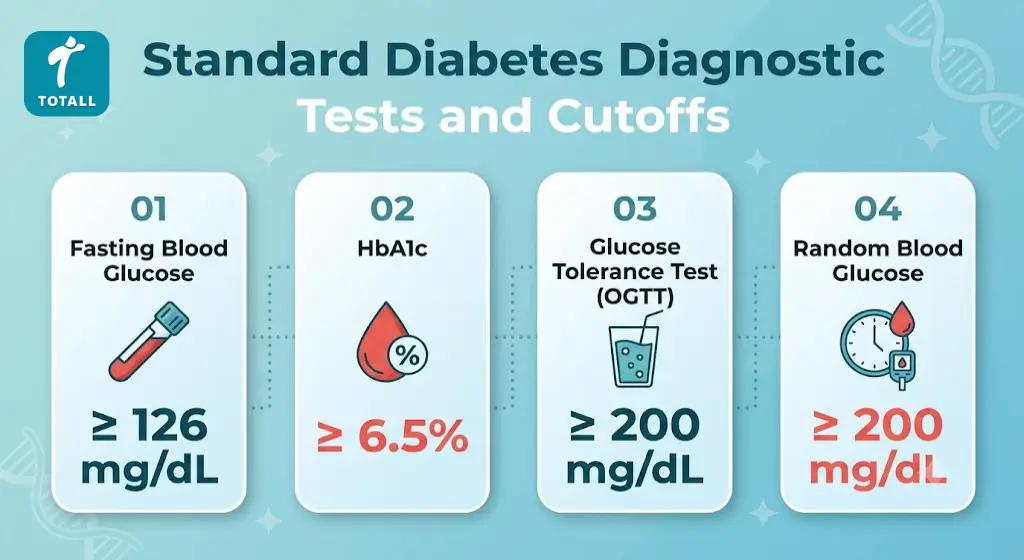
Diabetes is diagnosed with a blood test, not by symptoms. The main diabetes tests are a fasting plasma glucose (126 mg/dL or higher), an HbA1c (6.5% or higher), a 2-hour glucose after a 75 g glucose drink, called an OGTT (200 mg/dL or higher), and, if you already have classic symptoms, a random glucose of 200 mg/dL or higher. Prediabetes starts at a fasting glucose of 100 mg/dL, a 2-hour glucose of 140 mg/dL or an HbA1c of 5.7%.
Behind those numbers sit a lot of practical questions. Which test should you ask for first? Do you need to fast? Can you trust a home glucometer? Why did your HbA1c look normal when your sugar clearly was not? This guide walks through every common diabetes test, how to prepare, how to read the result, what can mislead it, which tests are done after diagnosis, and where to get them in Indore. If you are still wondering whether you need a test at all, start with our guide to the signs of diabetes.
Key points
- Ask for a fasting glucose, a post-meal or 75 g glucose test, and an HbA1c together. Each can miss what the others catch.
- You must fast for the fasting glucose and the OGTT. You do not need to fast for an HbA1c.
- HbA1c can be wrong in anaemia and in inherited haemoglobin variants, both common in India.
- A single abnormal result is usually repeated. A home glucometer reading is a prompt to test, not a diagnosis.
What this guide covers
- The main diabetes tests at a glance
- Fasting plasma glucose
- The 75 g glucose tolerance test (OGTT) and post-meal sugar
- HbA1c
- Random blood sugar
- Normal, prediabetes and diabetes ranges
- When the diabetes tests disagree
- Home glucometers and other home diabetes tests
- How to prepare
- Diabetes tests in pregnancy
- Tests after diagnosis
- Common mistakes
- Diabetes tests in Indore at TOTALL
- डायबिटीज की जांच (हिंदी में सार)
- Frequently asked questions
The main diabetes tests at a glance
Several tests can show diabetes, and they measure different things. Some give a snapshot of your sugar at one moment, and one gives an average over about three months. A doctor usually chooses one or more depending on your symptoms, risk and circumstances.
| Test | What it measures | Fasting needed? | Diabetes if |
|---|---|---|---|
| Fasting plasma glucose (FPG) | Sugar after at least 8 hours without food | Yes | 126 mg/dL or higher |
| 75 g oral glucose tolerance test (OGTT), 2-hour value | How your body handles a standard glucose load | Yes | 200 mg/dL or higher |
| HbA1c | Average sugar over about 3 months | No | 6.5% or higher |
| Random plasma glucose | Sugar at any time of day | No | 200 mg/dL or higher, with classic symptoms |
The thresholds come from the American Diabetes Association, and the same cutoffs are used by Indian guidelines and laboratories for diagnosis. Our guide to early signs of diabetes and prediabetes covers the prediabetes range in more depth.
Fasting plasma glucose
This is the most common of all diabetes tests. A blood sample is taken from a vein after an overnight fast, which means no food or drink other than plain water for at least eight hours. The sample is measured as plasma glucose in a laboratory. The fasting blood sugar normal range is below 100 mg/dL, 100 to 125 mg/dL is prediabetes, and 126 mg/dL or higher suggests diabetes.
Its strengths are simplicity and low cost. Its weakness, particularly in Indians, is that it can miss early diabetes. Many people in the early stage have a normal fasting sugar and a high sugar after meals, so a normal fasting result does not close the question if you have symptoms or risk factors. That is why a post-meal or 75 g glucose test and an HbA1c are often added.
The 75 g glucose tolerance test (OGTT) and post-meal sugar
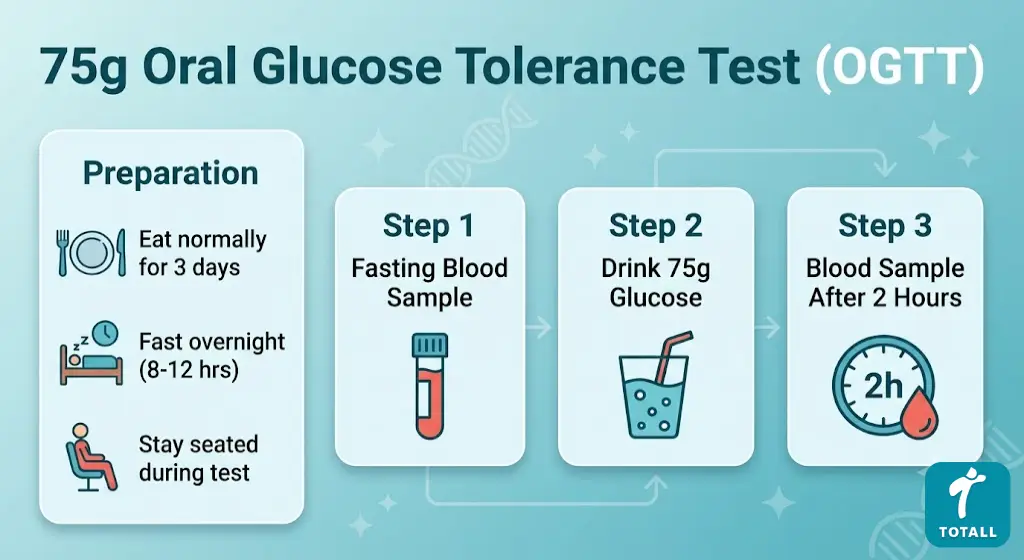
In an OGTT, you give a fasting blood sample, then drink 75 g of glucose dissolved in water over about five minutes, and give another blood sample two hours later. You wait seated in between, without eating, smoking or walking about. The two-hour value of 200 mg/dL or higher is diabetes, and 140 to 199 mg/dL is prediabetes. The test can find diabetes that a fasting sugar misses, and it is the standard test for diagnosing gestational diabetes and for assessing women with PCOS.
Many Indian laboratories also offer a post-prandial blood sugar (PPBS), taken two hours after a normal meal. It is widely used for screening and monitoring and is helpful when a person cannot manage the glucose drink, but for a formal diagnosis the standard is still the 75 g glucose load. If your PPBS is clearly high, for example above 200 mg/dL, it is a strong reason to see a doctor promptly.
HbA1c
HbA1c measures the percentage of haemoglobin in your red blood cells that has sugar attached to it. Because red cells live about three months, the result reflects your average sugar over that time, weighted toward the most recent weeks. It does not need fasting, can be taken at any time of day, and is not affected by what you ate that morning. The HbA1c normal range is below 5.7%, 5.7% to 6.4% is prediabetes, and 6.5% or higher suggests diabetes. The test should be performed in a laboratory using a method standardised to international reference systems.
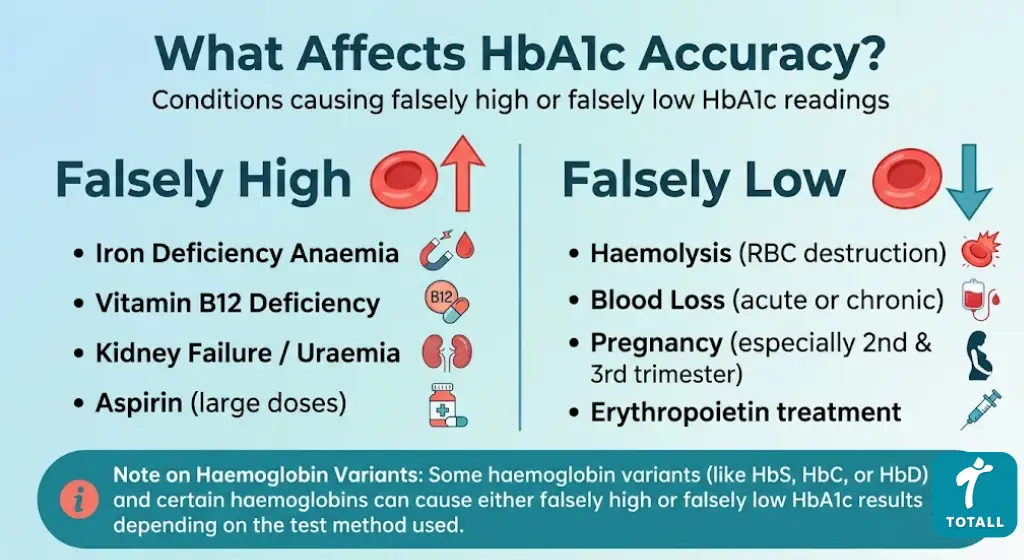
HbA1c is also used after diagnosis, every three to six months, to see how well treatment is working. But as a diagnostic test it has limits that matter in India. Anything that changes the lifespan or number of red blood cells can shift the result without a true change in sugar. Iron deficiency anaemia can push HbA1c up. Recent blood loss, a blood transfusion, haemolytic anaemia and some kidney problems can push it down. Inherited haemoglobin variants and thalassaemia trait, which are common in parts of India, can make some methods unreliable. If your HbA1c does not match how you feel or your glucose readings, ask your doctor to rely on glucose-based tests, and, if needed, on alternatives such as fructosamine or a different HbA1c method.
Random blood sugar
A random glucose is taken at any time without regard to meals. It is useful in two situations: when someone has classic symptoms such as thirst, frequent urination and weight loss, where a value of 200 mg/dL or higher confirms diabetes, and in an emergency. In a person with no symptoms, a random value is not enough to diagnose diabetes, though a high one is a reason to go for fasting, HbA1c or OGTT tests. A value in the normal range does not rule diabetes out.
Normal, prediabetes and diabetes ranges
The table below shows the HbA1c normal range and the fasting blood sugar normal range, together with the prediabetes and diabetes cutoffs, in both units. Indian laboratories report in mg/dL, while many international sources use mmol/L, and the conversion is to divide mg/dL by 18.
| Test | Normal | Prediabetes | Diabetes |
|---|---|---|---|
| Fasting plasma glucose | Below 100 mg/dL (5.6 mmol/L) | 100 to 125 mg/dL (5.6 to 6.9 mmol/L) | 126 mg/dL (7.0 mmol/L) or higher |
| 2-hour glucose after 75 g glucose | Below 140 mg/dL (7.8 mmol/L) | 140 to 199 mg/dL (7.8 to 11.0 mmol/L) | 200 mg/dL (11.1 mmol/L) or higher |
| HbA1c | Below 5.7% | 5.7% to 6.4% | 6.5% or higher |
| Random glucose with classic symptoms | 200 mg/dL (11.1 mmol/L) or higher |
Some laboratories and guidelines, including the World Health Organization, begin the prediabetes range for fasting glucose at 110 mg/dL, not 100. If two reports label the same fasting value differently, this is likely why.
To translate an HbA1c into an average glucose, a commonly used formula gives these approximate values: 5.7% is about 117 mg/dL, 6.5% about 140 mg/dL, 7% about 154 mg/dL, 8% about 183 mg/dL and 9% about 212 mg/dL. Targets for people who already have diabetes differ from these diagnostic cutoffs and depend on age, other illnesses and treatment, so they should be agreed with your own doctor.
When the diabetes tests disagree
It is common for one test to be abnormal and another normal. A person may have a fasting glucose of 108 and an HbA1c of 6.7%, or an HbA1c of 5.4% and a 2-hour glucose of 215. The rules doctors follow are straightforward. If two different tests from the same sample are both above the diabetes cutoff, the diagnosis is confirmed. If two results disagree, the test that is above the cutoff is repeated. In a person with classic symptoms and a clearly high glucose, no confirmation is needed.
Disagreement is also where HbA1c’s limits show up. If your HbA1c says “normal” but your fasting and post-meal sugars are high, trust the glucose results. If your HbA1c says “diabetes” but you are anaemic, repeat it after treating the anaemia, or confirm with a glucose-based test.
Home glucometers and other home diabetes tests
A home glucometer measures glucose in a fingerprick drop of capillary blood. It is a very useful tool for people with diabetes, and it can be a quick blood sugar test if you feel unwell. It is not used to diagnose diabetes, because readings can differ from laboratory plasma glucose by a noticeable margin. International standards allow meters to deviate by about 15% from a laboratory value, and technique, strip storage and dirty hands all add error.
So how should you use a home reading? If your fasting reading is repeatedly 126 or higher, or a random reading is above 200 with symptoms, treat that as a reason to book a laboratory test and a doctor visit within days. Do not start or change treatment based on a home reading alone. If you decide to buy a meter, choose a reputable brand, check the expiry date on the strips, wash and dry your hands before testing, and bring the meter to your doctor once to compare against a lab result.
Mail-in or at-home HbA1c kits exist, but they are best treated as screening tools, and a lab test is still needed to confirm. Smartwatches and fitness bands that claim to estimate blood sugar are not validated for diagnosis. Continuous glucose monitors (CGM) are excellent for managing diabetes, and TOTALL offers continuous glucose monitoring, but they are not used to diagnose it.
How to prepare for diabetes tests
Good preparation for any blood sugar test prevents repeat visits and misleading results.
For a fasting glucose. Fast for 8 to 12 hours, with water only. Take the test in the morning. Do not drink tea, coffee with sugar, juice or smoke before the sample. Ask your doctor whether to take your regular medicines that morning, particularly if you already use diabetes medicines or steroids.
For an OGTT. Eat your usual meals, including carbohydrates, for three days before. Do not cut down on rice or roti to “prepare”, because that can falsely raise the result. Fast overnight. During the test, stay seated, do not eat, smoke or chew gum, and drink only water. Plan for about two to three hours at the laboratory.
For an HbA1c. No fasting is needed. Tell the laboratory if you have had recent bleeding, a transfusion or anaemia treatment.
For all tests. Avoid testing during an acute illness, infection or major stress if you can, because these temporarily raise sugar. Mention steroids, other medicines and supplements. And do not change your diet for several days beforehand, because it can hide the problem you are trying to find.
Diabetes tests in pregnancy
In pregnancy, the diagnosis of gestational diabetes uses a 75 g glucose test with lower thresholds. In India, a single-step test is widely used: a 75 g glucose drink taken without regard to fasting, with a blood test two hours later, and a result of 140 mg/dL or higher indicates gestational diabetes. Women with risk factors are tested early and again at 24 to 28 weeks. HbA1c is less reliable in pregnancy, because red cell turnover changes. Our page on gestational diabetes and the pregnancy diabetes clinic explain follow-up.
Tests after diagnosis
The first test confirms that you have diabetes. The next set tells you what diabetes has already done, and what your starting point is. At diagnosis, and then at regular intervals, doctors usually look at the following.
Blood sugar control: HbA1c every three to six months, with home or continuous glucose readings as advised. Kidneys: creatinine with estimated GFR, and a urine albumin to creatinine ratio, at least yearly, to catch kidney damage early. Heart and vessels: blood pressure at every visit, a lipid profile at least yearly, and an ECG or other heart tests when indicated. Liver: liver enzymes, because fatty liver is common. Eyes: a dilated retinal examination at diagnosis in type 2, and then regularly. Feet and nerves: a foot examination and nerve sensitivity testing yearly. Thyroid: TSH, particularly in type 1 diabetes and in women. Vitamin B12: in people on metformin, periodically.
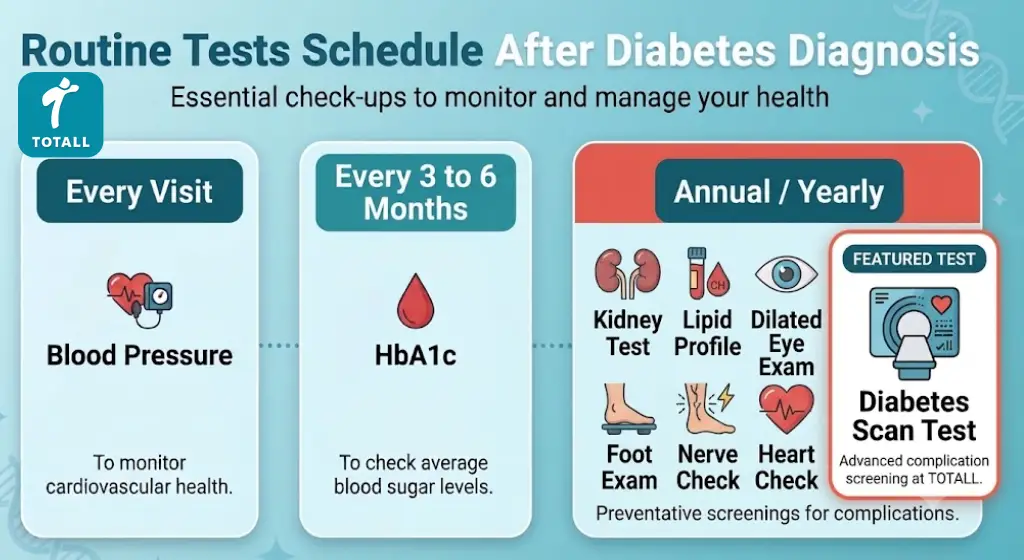
TOTALL’s Diabetes Body Checkup is designed around exactly this list, as an annual report card of the organs diabetes can affect. According to TOTALL, the Diabetes Scan includes blood sugar tests, kidney and liver tests, lipid profile, urine microalbumin, TSH, chest X-ray, abdominal ultrasound, ECG, vascular Doppler, a podiatry scan and nerve and autonomic testing, and the Diabetes Full Body Scan adds a DEXA bone scan, echocardiography, a treadmill test and an eye and retina examination. To understand why each organ matters, read how diabetes affects the body.
Common mistakes with diabetes tests
The same handful of errors cause most confusion. People eat or drink something sweet before a “fasting” test. They go on a strict diet for a week before an OGTT and get a falsely high result. They rely on a fasting sugar alone and are told they are fine, when the post-meal sugar is high. They trust a single home glucometer reading, in either direction. They accept a normal HbA1c without knowing they are anaemic. They ignore a borderline result and do not repeat it. And they test only when they feel ill, which can reflect a temporary rise from infection or stress.
If you take one practical lesson from this guide, it is to ask for the three diabetes tests together, to take them under ordinary conditions, and to repeat any borderline value.
Diabetes tests in Indore at TOTALL
If you live in Indore, Ujjain, Dewas or elsewhere in Madhya Pradesh, you can get your diabetes tests done at TOTALL Diabetes Hormone Institute. The institute has its own pathology laboratory, and you can see the range of tests on the investigations page. For a broader health review, see the body checkup packages. Results are reviewed with an endocrinologist, which matters because the same number can mean different things in different people.
Prices vary by test and package, so it is reasonable to ask for an itemised quote before you book. If you are not sure which test to choose, a consultation first can save you from paying for tests you do not need.
Book a diabetes test or consultation in Indore
TOTALL Diabetes Hormone Institute, BCM Health Island, Scheme No 54 (near Bombay Hospital and behind Prestige Management Institute), Indore, Madhya Pradesh 452010.
Open Monday to Saturday, 8:00 AM to 8:00 PM. Sunday closed.
Call 0731 244 3344 or 093024 43344, message on WhatsApp, or book an appointment online.
डायबिटीज की जांच (हिंदी में सार)
डायबिटीज की जांच खून के टेस्ट से होती है, सिर्फ लक्षणों से नहीं। मुख्य टेस्ट हैं: खाली पेट शुगर (126 mg/dL या ज्यादा), HbA1c (6.5% या ज्यादा), 75 ग्राम ग्लूकोज पीने के 2 घंटे बाद की शुगर (200 mg/dL या ज्यादा), और लक्षण होने पर रैंडम शुगर (200 mg/dL या ज्यादा)। प्रीडायबिटीज में खाली पेट शुगर 100 से 125, खाने के बाद 140 से 199 और HbA1c 5.7% से 6.4% होता है।
सबसे अच्छा तरीका है कि खाली पेट शुगर, खाने के बाद की शुगर और HbA1c तीनों एक साथ कराएं। HbA1c के लिए खाली पेट रहना जरूरी नहीं है, लेकिन खून की कमी (एनीमिया) में यह गलत आ सकता है। घर के ग्लूकोमीटर की एक रीडिंग से डायबिटीज की पुष्टि नहीं होती, लैब टेस्ट जरूर कराएं। इंदौर में जांच के लिए TOTALL में 0731 244 3344 पर संपर्क करें।
Frequently asked questions about diabetes tests
Which tests diagnose diabetes?
The main diabetes tests are fasting plasma glucose (126 mg/dL or higher), HbA1c (6.5% or higher), a 2-hour glucose after a 75 g glucose drink (200 mg/dL or higher), and a random glucose of 200 mg/dL or higher in someone with classic symptoms. A doctor may use one or more, and often repeats a borderline result.
Which is the best test for diabetes?
No single test is best for everyone. Fasting glucose is simple and cheap, HbA1c is convenient and needs no fasting, and the 75 g OGTT is the most sensitive for early diabetes. In India, asking for fasting glucose, post-meal glucose and HbA1c together gives the clearest picture.
Do I need to fast for an HbA1c test?
No. HbA1c reflects average sugar over about three months, so it can be taken at any time of day without fasting. You do need to fast for a fasting glucose and for the glucose tolerance test.
What is a normal fasting blood sugar?
A normal fasting plasma glucose is below 100 mg/dL. A value of 100 to 125 mg/dL indicates prediabetes, and 126 mg/dL or higher suggests diabetes. Some guidelines, including WHO, begin the prediabetes range at 110 mg/dL.
Is HbA1c enough to diagnose diabetes?
Usually it is a valid test, but it can mislead in anaemia, iron deficiency, thalassaemia trait, haemoglobin variants and some kidney conditions. If your HbA1c does not match your symptoms or glucose readings, your doctor should rely on glucose-based tests as well.
Can I diagnose diabetes at home with a glucometer?
No. A home glucometer is for monitoring, and its readings can differ from laboratory values by around 15%. A high home reading, especially repeated, is a reason to get a laboratory test and see a doctor, not a diagnosis by itself.
How should I prepare for a glucose tolerance test?
Eat normally, including carbohydrates, for three days before the test and fast overnight for 8 to 12 hours. On the day, stay seated, avoid eating, smoking and chewing gum, and drink only water. The test takes about two to three hours.
Is post-meal sugar (PPBS) enough to diagnose diabetes?
A clearly high PPBS is a strong warning and needs medical follow-up, but the standard for diagnosis is the 75 g glucose tolerance test, fasting glucose or HbA1c. Your doctor may use PPBS for screening and monitoring.
How often should I get tested for diabetes?
If your results are normal, repeat the tests every one to three years, or yearly if you have risk factors such as belly fat, family history or PCOS. If you have prediabetes, test at least once a year. If you have diabetes, HbA1c is checked every three to six months.
What tests are done after diabetes is diagnosed?
Doctors usually check HbA1c, kidney tests including urine albumin, a lipid profile, liver tests, blood pressure, an eye examination, and foot and nerve checks, then repeat most of them yearly. Some people also need thyroid and vitamin B12 tests and a heart assessment.
Where can I get diabetes tests done in Indore?
You can get diabetes tests and see an endocrinologist at TOTALL Diabetes Hormone Institute, BCM Health Island, Scheme No 54, Indore. It is open Monday to Saturday from 8:00 AM to 8:00 PM. Call 0731 244 3344 or book through the appointment page.
References and further reading
- American Diabetes Association. Standards of Care in Diabetes, sections on classification and diagnosis and on comprehensive medical evaluation. professional.diabetes.org.
- World Health Organization. Diabetes fact sheet. who.int.
- NHS. Diagnosis of type 2 diabetes. nhs.uk.
- Anjana RM, et al. ICMR-INDIAB national cross-sectional study. Lancet Diabetes Endocrinol. 2023. Read the paper.
- Research Society for the Study of Diabetes in India (RSSDI). Clinical practice recommendations.
- Ministry of Health and Family Welfare, India. Gestational diabetes mellitus, technical and operational guidelines.