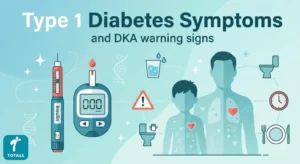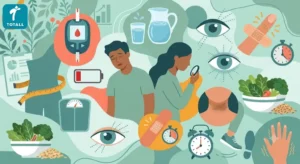
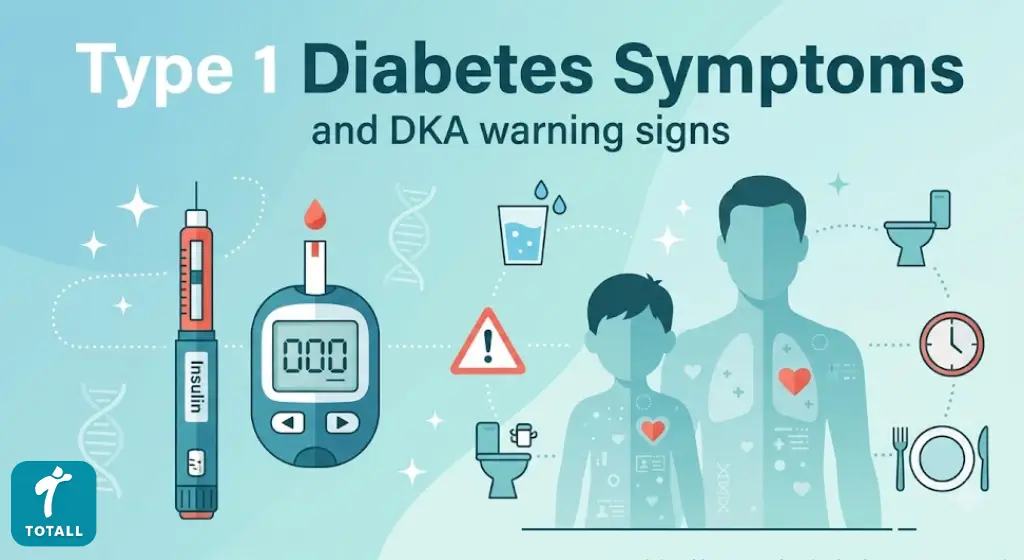
Type 1 diabetes symptoms come on quickly, over days to a few weeks: intense thirst, frequent urination, rapid weight loss, tiredness and hunger, sometimes with nausea, stomach pain and fruity-smelling breath. Type 2 diabetes symptoms build slowly over months or years, and many people have none. Both types can cause the same basic signs, so type 1 vs type 2 diabetes symptoms are best told apart by the speed of onset, the age and body type, and a few blood tests are what tell them apart.
Telling them apart matters more than it may seem. Type 1 diabetes needs insulin from the start, and without it a person can slide into diabetic ketoacidosis (DKA), a medical emergency, within hours to days. Our main guide to the signs of diabetes gives a short comparison. This article goes further: how type 1 diabetes symptoms differ in adults and children, why a thin adult labelled “type 2” may be wrong, which tests settle it, and how to recognise and act on DKA.
Key points
- Type 1 diabetes can start at any age. A large share of new cases are diagnosed in adults, and many are first treated as type 2.
- Rapid weight loss, intense thirst and tiredness together point to type 1 or to very high sugar, and need a same-day blood test.
- Vomiting, abdominal pain, fast deep breathing or drowsiness with high sugar is DKA until proven otherwise. Go to a hospital immediately.
- Someone with type 1 diabetes must never stop insulin, even when sick or not eating.
What this guide covers
- Type 1 vs type 2 diabetes symptoms: the core difference
- Type 1 diabetes symptoms
- Type 1 diabetes symptoms in adults, and LADA
- Type 2 diabetes symptoms
- Type 1 vs type 2 diabetes symptoms at a glance
- Type 1 diabetes symptoms or type 2? The tests that settle it
- Diabetic ketoacidosis symptoms and what to do
- Sick day rules and ketone checks
- The type 2 emergency: hyperosmolar state
- How treatment differs
- Living with type 1 diabetes
- What to do next, and care in Indore
- टाइप 1 और टाइप 2 डायबिटीज के लक्षण (हिंदी में सार)
- Frequently asked questions
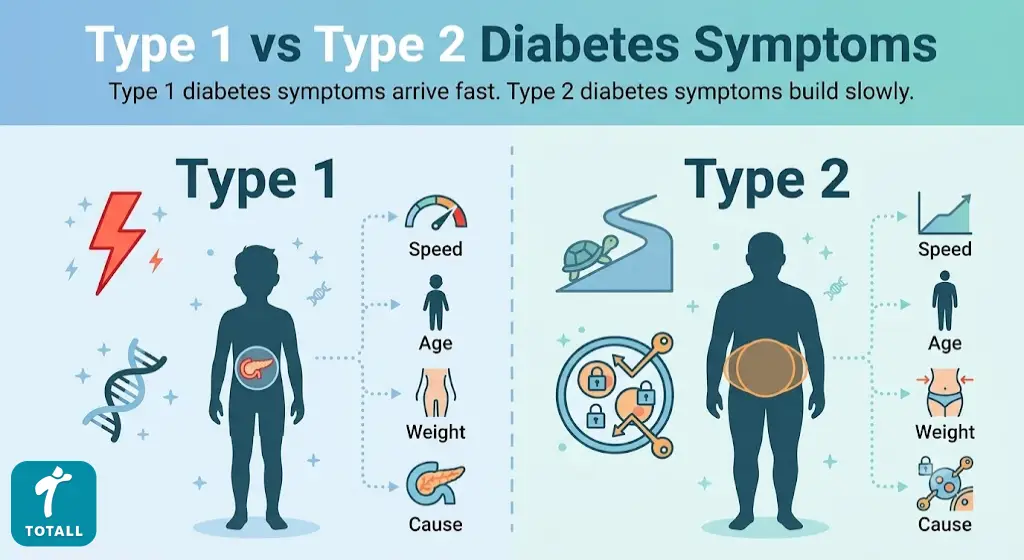
Type 1 vs type 2 diabetes symptoms: the core difference
The two types share a name and a symptom list, but they are different diseases. In type 1 diabetes, the immune system mistakenly destroys the insulin-making beta cells of the pancreas. Insulin falls sharply, often to near zero, and cannot be replaced by tablets or lifestyle change. It is not caused by sugar, diet or obesity, and it cannot be prevented with current knowledge.
In type 2 diabetes, the body still makes insulin but the cells respond poorly to it (insulin resistance), and over time the pancreas cannot make enough. It is strongly linked to belly fat, inactivity, family history and age, and it accounts for the large majority of all diabetes. That is why type 2 symptoms are slow and quiet, while type 1 diabetes symptoms are loud and fast: in type 1 the insulin supply collapses over weeks, whereas in type 2 sugar creeps up over years.
Type 1 diabetes symptoms
The classic type 1 diabetes symptoms are the same as the general signs of diabetes, only more intense and quicker to appear. Because insulin is so low, glucose cannot enter cells at all, so the body runs on fat and muscle and the blood sugar climbs steeply.
The main type 1 diabetes symptoms
Intense thirst and frequent urination. The urine volume can be large enough to wake a child several times a night, or to cause bedwetting in a child who had been dry for years. The mechanism is the same glucose spill we describe in our guide to the 8 classic signs of diabetes, only faster.
Rapid, unexplained weight loss. This is the sign that most separates type 1 from type 2. A person may lose several kilograms within a few weeks despite eating well. The body is burning its own fat and muscle because it cannot use the glucose in the blood.
Tiredness, weakness and hunger. Cells starved of glucose cause profound fatigue, and the body signals hunger even after meals. Children may seem unusually irritable, sleepy or unable to concentrate at school.
Blurry vision, and recurrent infections. Fluctuating focus and fungal infections (genital thrush, skin infections) occur as in other types of diabetes.
The warning signs that mean DKA is developing
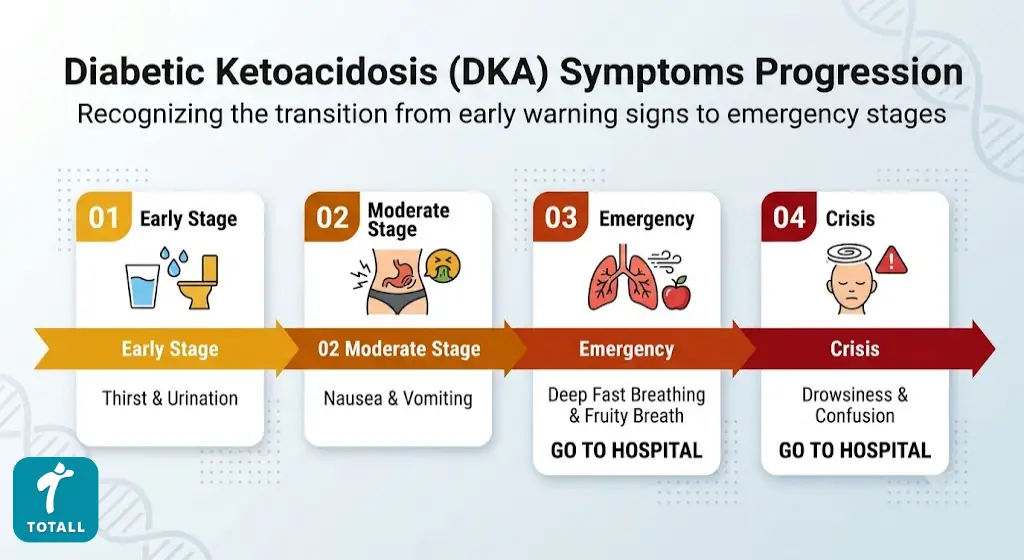
If insulin is very low for long enough, ketones build up and the blood turns acidic. The early signs of DKA overlap with the classic type 1 diabetes symptoms, but the later ones are different: nausea and vomiting, stomach pain that can be mistaken for appendicitis or gastroenteritis, fast deep breathing, a fruity or nail-polish smell on the breath, and drowsiness or confusion. A significant number of people are diagnosed with type 1 diabetes only when they reach hospital with DKA, especially children whose early symptoms were put down to a stomach bug or exam stress. This is covered in full in the DKA section below.
Type 1 diabetes symptoms in adults, and LADA
Many people believe type 1 diabetes is a childhood disease. It is not. It can start at any age, and a considerable share of new cases are diagnosed in adults, sometimes in the 30s, 40s or later. Type 1 diabetes symptoms in an adult can be milder and slower than in a child, which is why adult type 1 diabetes is often misdiagnosed as type 2.
A particular form is called latent autoimmune diabetes in adults (LADA). It looks like type 2 at the start: it appears in adults, often without sudden weight loss, and tablets may work for a while. But it is autoimmune, and the beta cells fail over months to a few years, so insulin becomes necessary sooner than in true type 2. Warning clues that an adult may have type 1 or LADA rather than type 2 include:
- A normal or low body weight, with no belly fat.
- Significant weight loss before diagnosis.
- Another autoimmune condition, such as thyroid disease, vitiligo or coeliac disease, in the person or family.
- Poor response to tablets within the first year or two.
- Ketones in the urine at diagnosis.
If this sounds like you or a family member, ask your doctor about antibody and C-peptide testing, described below. The condition is covered further on our type 1 diabetes page.
Type 2 diabetes symptoms
Type 2 diabetes symptoms are the slow version of the same signs, unlike type 1 diabetes symptoms, which are abrupt: more urination, thirst, tiredness, blurry vision, repeated infections and slow-healing wounds. Weight loss, when it happens, is gradual. Many people have no symptoms for years, and diabetes is found on a routine test or when a complication appears. Quiet clues such as a waist above the Indian cutoff and dark neck patches often come first. These are covered in detail in our guide to the early signs of diabetes and prediabetes, so we will not repeat them here.
People with type 2 diabetes can also reach an emergency, though by a different route: the hyperosmolar state, described below. And although type 2 is far more common in adults, it is increasingly found in overweight teenagers and young adults in India, which is one reason age alone is never enough to tell the types apart.
Type 1 vs type 2 diabetes symptoms at a glance
| Type 1 diabetes | Type 2 diabetes | |
|---|---|---|
| Cause | Autoimmune destruction of beta cells | Insulin resistance plus a pancreas that gradually tires |
| Insulin in the body | Very low or absent | Normal or high at first, then falls |
| Share of all diabetes | A small minority (roughly 5 to 10 percent) | The large majority |
| Usual age at diagnosis | Childhood, teens, young adults, but any age | Usually adults, increasingly younger |
| Speed of symptoms | Days to weeks | Months to years, often silent |
| Body weight | Often thin or losing weight fast | Often overweight, with belly fat |
| Ketones and DKA | High risk, even at diagnosis | Low risk, but possible in severe illness |
| Family history | Less strong | Strong |
| Can it be prevented? | No known way | Often delayed or prevented with lifestyle change |
| Treatment | Insulin always, from the start | Lifestyle, tablets, injectables and sometimes insulin |
| Remission possible? | Partial remission (“honeymoon”) only, not a cure | Remission possible with substantial weight loss |
Use the table as a quick guide to type 1 diabetes symptoms versus type 2, but remember that exceptions are common, and only tests can confirm the type.
Type 1 diabetes symptoms or type 2? The tests that settle it
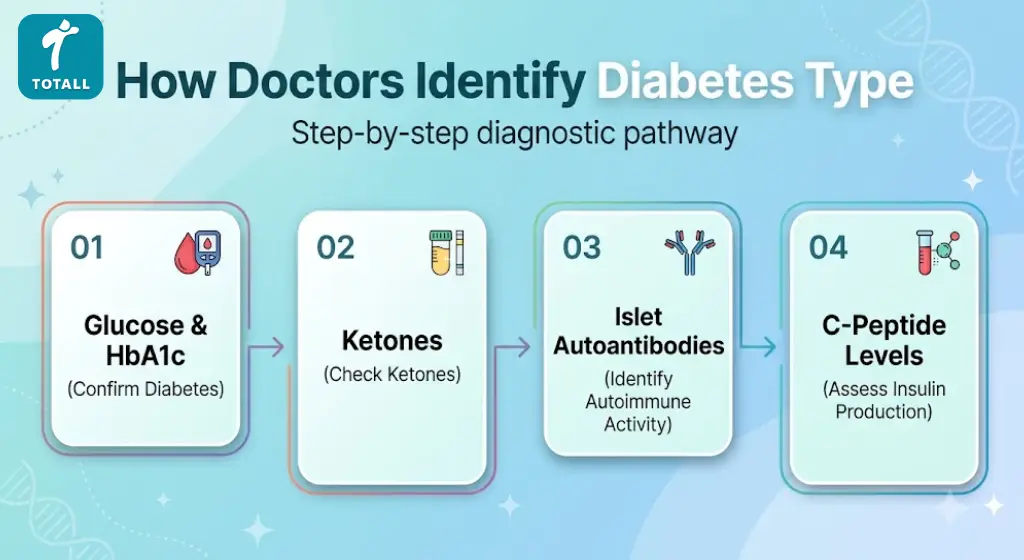
Type 1 diabetes symptoms alone cannot confirm the type, and neither can type 2 diabetes symptoms. Glucose tests tell you that diabetes is present: a fasting glucose of 126 mg/dL or higher, a 2-hour glucose of 200 mg/dL or higher, or an HbA1c of 6.5% or higher. They do not tell you the type. When the picture is mixed, an endocrinologist may add these tests.
Islet autoantibodies (such as GAD65, IA-2 and ZnT8). Their presence points to autoimmune diabetes, meaning type 1 or LADA. C-peptide, a marker of how much insulin the pancreas is still making. A low level supports type 1, while a normal or high level suggests type 2. Ketones in blood or urine at diagnosis suggest very low insulin. Taken together, these answer the question that matters: does this person need insulin now, and will they need it for life?
Two other types are worth knowing because they hide behind these labels. MODY (maturity-onset diabetes of the young) is a rare inherited form that appears in young people, often with a strong family history across generations and no obesity, and some forms respond to tablets rather than insulin. In India, a form linked to pancreatic damage, sometimes called fibrocalculous pancreatic diabetes, is also seen in younger, thin people. Both are reasons not to settle for a label on appearance alone.
Diabetic ketoacidosis symptoms and what to do
DKA happens when the body has too little insulin, so it breaks down fat for fuel and releases large amounts of ketones. Ketones are acids, and in excess they make the blood dangerously acidic. High sugar adds dehydration, and the combination can lead to coma if untreated. It is most common in type 1 diabetes but can occur in type 2, especially during severe illness.
What triggers it
The most common triggers are missed or too-low insulin doses, an infection or illness (urinary tract infection, pneumonia, gastroenteritis), a new diagnosis of type 1 diabetes, and a faulty insulin pump or pen. Other triggers include heart attack, steroid medicines, heavy alcohol use and pregnancy. People with type 2 diabetes who take a group of medicines called SGLT2 inhibitors have a small but real risk of DKA, and in them it can occur with only mildly raised blood sugar, which is called euglycaemic DKA. This can be missed because the reading looks reassuring. If you take one of these medicines and feel suddenly unwell with nausea, vomiting, abdominal pain or fast breathing, seek care even if your sugar is not very high.
The signs, in the order they usually appear
Diabetic ketoacidosis symptoms usually follow a predictable order. The early signs are the usual high-sugar ones: intense thirst, passing a lot of urine, tiredness and a dry mouth. As ketones rise, nausea and vomiting appear, often with pain across the upper abdomen. Breathing becomes deep and fast as the body tries to blow off acid (Kussmaul breathing), and the breath may smell of acetone or fruit. Later come drowsiness, confusion and, if untreated, loss of consciousness.
What to do
If you or someone with diabetes has high sugar together with vomiting, abdominal pain, fast deep breathing, a fruity smell on the breath, marked drowsiness or confusion, go to an emergency department immediately or call 112. Do not wait to see whether it improves, do not try to treat it with water, fruit juice or home remedies, and do not drive yourself if you feel drowsy. If the person is unconscious, do not put anything in the mouth.
In hospital, treatment is carried out under close monitoring: fluids through a drip, insulin, and replacement of potassium and other salts as needed, along with finding and treating the trigger. Most people recover fully when treated promptly.
Sick day rules and ketone checks
For anyone with type 1 diabetes, illness is the time to be most careful. The rules that prevent most DKA episodes are simple.
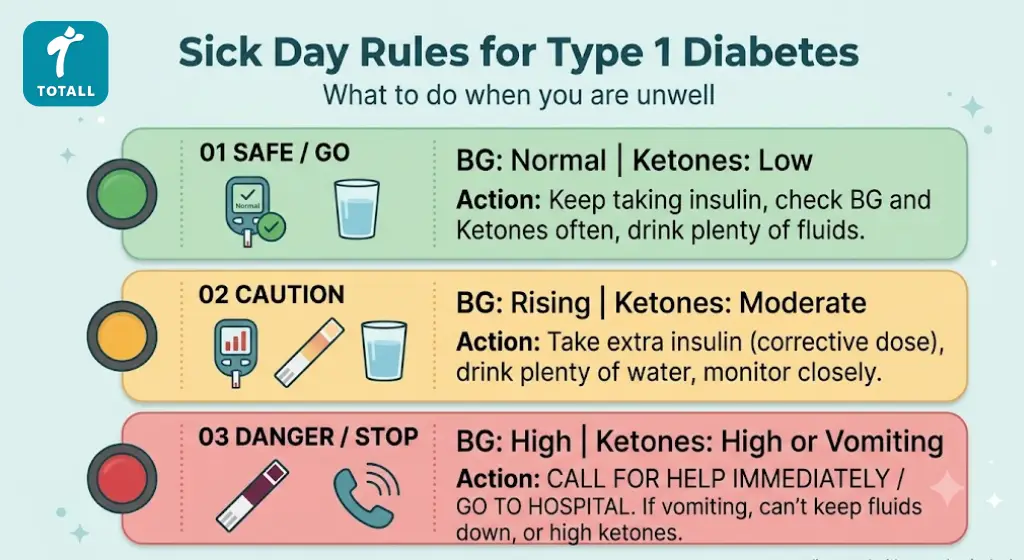
Never stop insulin, even if you are not eating or are vomiting. Illness usually raises insulin needs, and missing a dose is the commonest route to DKA. Check your blood sugar every two to four hours, and check ketones if sugar is above about 250 mg/dL, or whenever you have vomiting, abdominal pain or feel generally unwell. Drink plenty of sugar-free fluids. Call your diabetes team early, not when things are already bad.
For blood ketones, a reading below 0.6 mmol/L is normal, 0.6 to 1.5 is slightly raised and needs watching, 1.6 to 2.9 is high and needs medical advice the same day, and 3.0 or above is an emergency. Urine strips are less precise: moderate or large ketones with high sugar or symptoms need urgent advice. Do not exercise when ketones are present.
The type 2 emergency: hyperosmolar state
People with type 2 diabetes can develop a different emergency called the hyperosmolar hyperglycaemic state. Sugar becomes extremely high over days, usually during an infection or when fluids are low, and severe dehydration and confusion follow. Ketones are usually low, so breathing is not as deep, which is why it can go unrecognised. It is seen more often in older people. The advice is the same: confusion, extreme thirst and weakness with very high sugar mean a hospital, not home care. Our main guide also lists these emergency signs.
How treatment differs
Type 1 diabetes always needs insulin, given by injections several times a day or through a pump, adjusted for food, activity and sugar readings. There is currently no tablet or lifestyle change that replaces it. Type 2 diabetes is treated according to the stage: lifestyle change and weight loss first, tablets, injectable non-insulin medicines, and insulin when needed. Some people with type 2 diabetes who lose a substantial amount of weight can achieve remission, meaning normal sugar without medicines, though this is not the same as a permanent cure, and sugar still needs regular testing. Type 1 diabetes does not go into lasting remission. Some people have a “honeymoon” phase soon after diagnosis in which the pancreas still makes some insulin and doses fall for a few months, but this does not mean insulin can be stopped.
Living with type 1 diabetes
Learning to recognise type 1 diabetes symptoms early, in yourself or your child, is the first line of defence. With insulin and good monitoring, most people with type 1 diabetes lead full, active lives, including careers, sport, marriage and pregnancy. Modern tools help a great deal. Continuous glucose monitoring shows sugar trends in real time and alerts you to highs and lows, and insulin pumps and newer automated systems can reduce the burden. TOTALL provides continuous glucose monitoring and ongoing sugar control support.
Low blood sugar is a bigger day-to-day risk in type 1 diabetes than in type 2, because insulin lowers sugar directly. Trembling, sweating, a racing heart, hunger and confusion mean sugar below about 70 mg/dL and need fast-acting sugar right away, then a recheck after 15 minutes. If you live with someone who has type 1 diabetes, learn these signs and what to do. Long term, regular screening of eyes, kidneys, nerves and feet applies to both types, as explained in how diabetes affects the body.
What to do next, and care in Indore
If you or your child has type 1 diabetes symptoms such as rapid weight loss, intense thirst and frequent urination, get a blood sugar test the same day. Do not wait for symptoms to become severe. If vomiting, abdominal pain or fast deep breathing are present, go straight to a hospital. If you have been told you have type 2 diabetes but you are thin, losing weight or not responding to tablets, ask about antibody and C-peptide testing. And if you have type 1 diabetes, never stop insulin without medical advice.
At TOTALL Diabetes Hormone Institute in Indore, you can see an endocrinologist who treats all types of diabetes, including type 1 diabetes. For general diabetes care, see our diabetes treatment page, and for women planning pregnancy with diabetes, our pregnancy diabetes clinic. Once diabetes is confirmed, TOTALL’s Diabetes Body Checkup is designed as an annual report card of the organs diabetes can affect.
Book a diabetes test or consultation in Indore
TOTALL Diabetes Hormone Institute, BCM Health Island, Scheme No 54 (near Bombay Hospital and behind Prestige Management Institute), Indore, Madhya Pradesh 452010.
Open Monday to Saturday, 8:00 AM to 8:00 PM. Sunday closed. For emergencies such as vomiting with high sugar, go to the nearest hospital or call 112.
Call 0731 244 3344 or 093024 43344, message on WhatsApp, or book an appointment online.
टाइप 1 और टाइप 2 डायबिटीज के लक्षण (हिंदी में सार)
टाइप 1 डायबिटीज के लक्षण तेजी से, कुछ दिनों या हफ्तों में आते हैं: बहुत प्यास, बार-बार पेशाब, तेजी से वजन घटना, थकान और भूख। बच्चे में बिस्तर गीला करना भी एक संकेत हो सकता है। टाइप 2 में लक्षण धीरे-धीरे बनते हैं और कई लोगों में सालों तक कोई लक्षण नहीं होता। टाइप 1 किसी भी उम्र में हो सकता है, सिर्फ बच्चों में नहीं।
अगर शुगर ज्यादा हो और साथ में उल्टी, पेट दर्द, तेज गहरी सांस, सांस में फल जैसी गंध या बेहोशी जैसी हालत हो, तो यह डायबिटिक कीटोएसिडोसिस (DKA) हो सकता है। तुरंत अस्पताल जाएं या 112 पर कॉल करें। टाइप 1 में इंसुलिन कभी बंद न करें, बीमारी में भी नहीं। इंदौर में जांच और परामर्श के लिए TOTALL में 0731 244 3344 पर संपर्क करें।
Frequently asked questions about type 1 and type 2 diabetes symptoms
What are the symptoms of type 1 diabetes?
Type 1 diabetes symptoms include intense thirst, frequent urination, rapid weight loss, tiredness and hunger, often appearing over days to weeks. Children may start wetting the bed. Nausea, vomiting, abdominal pain and fruity-smelling breath suggest diabetic ketoacidosis and need emergency care.
What is the difference between type 1 and type 2 diabetes symptoms?
Both cause thirst, frequent urination, tiredness and blurry vision. Type 1 symptoms start fast, usually with weight loss and a risk of ketoacidosis. Type 2 symptoms build slowly over months or years and are often absent. Blood tests, and sometimes antibody and C-peptide tests, confirm the type.
Can type 1 diabetes develop in adults?
Yes. Type 1 diabetes can start at any age, and many new cases are diagnosed in adults. In adults it can be slower and milder at first, which is why it is often mistaken for type 2. A thin adult with weight loss or poor response to tablets should be tested for autoimmune diabetes.
What is LADA?
LADA, latent autoimmune diabetes in adults, is a slow-onset form of autoimmune diabetes. It looks like type 2 at first, but the beta cells fail over months to a few years, so insulin is needed sooner than in true type 2. Antibody and C-peptide tests help identify it.
Is type 1 diabetes more serious than type 2?
They are different, and both are serious. Type 1 carries a higher immediate risk of ketoacidosis and needs insulin for life. Type 2 is often found late, so complications can already be present. Both can be managed well with early diagnosis, treatment and regular monitoring.
What are the signs of diabetic ketoacidosis?
Early signs are thirst, frequent urination and tiredness. Later signs are nausea, vomiting, abdominal pain, fast deep breathing, a fruity breath smell, drowsiness and confusion. High sugar with vomiting or deep breathing is an emergency. Go to a hospital immediately and do not wait to see if it improves.
Can you get ketoacidosis with type 2 diabetes?
It is less common but possible, especially during severe illness. People taking SGLT2 inhibitors can develop DKA even when blood sugar is only mildly raised. If you take these medicines and feel suddenly unwell with nausea, vomiting or abdominal pain, seek medical care.
When should I check ketones?
People with type 1 diabetes should check ketones when blood sugar is above about 250 mg/dL, or when they have vomiting, abdominal pain or feel unwell. Moderate or large urine ketones, or blood ketones of 1.6 mmol/L or above, need urgent medical advice. Never stop insulin during illness.
Can you live a normal life with type 1 diabetes?
Yes. With insulin, regular monitoring and support, most people with type 1 diabetes study, work, play sport and have families. Continuous glucose monitors and insulin pumps make daily management easier. Regular screening of eyes, kidneys, nerves and feet remains important.
Can type 2 diabetes be cured?
Type 2 diabetes cannot be called cured, but remission is possible in some people who lose a substantial amount of weight, meaning normal sugar without medicines. Regular testing is still needed, because sugar can rise again. Type 1 diabetes does not go into lasting remission.
Where can I get type 1 diabetes treated in Indore?
You can consult an endocrinologist at TOTALL Diabetes Hormone Institute, BCM Health Island, Scheme No 54, Indore. It is open Monday to Saturday from 8:00 AM to 8:00 PM. You can call 0731 244 3344 or book through the appointment page. For emergencies, go to the nearest hospital.
References and further reading
- American Diabetes Association. Standards of Care in Diabetes, including sections on classification and on hyperglycaemic crises. professional.diabetes.org.
- World Health Organization. Diabetes fact sheet. who.int.
- NHS. Type 1 diabetes. nhs.uk.
- International Diabetes Federation. IDF Diabetes Atlas. diabetesatlas.org.
- Diabetes UK. Diabetic ketoacidosis (DKA) and ketone testing.
- Lean MEJ, et al. Primary care-led weight management for remission of type 2 diabetes (DiRECT). Lancet. 2018.
About this article. Written and medically reviewed by Dr. Sunil M Jain, DM (Endocrinology), Chairman and Managing Director of TOTALL Diabetes Hormone Institute (Madhya Pradesh Medical Council registration MP-2912, MCI registration 13607).