

What BMI Actually Measures
BMI, or Body Mass Index, is a simple ratio: your weight in kilograms divided by the square of your height in metres. If you weigh 70 kg and stand 1.65 m tall, that’s 70 ÷ (1.65 × 1.65), or 70 ÷ 2.72, which comes to roughly 25.7.
The underlying index dates to the 19th century, when Belgian statistician Adolphe Quetelet developed it as a way of describing population averages, not as an individual diagnostic tool. The modern term “body mass index” came later, and it has stuck around clinically because it’s cheap, fast, and correlates reasonably well with body fat across most people. What it can’t do is tell the difference between fat and muscle, and it can’t tell you where fat is stored on your body, which, as covered in the main obesity guide, matters more for health risk than total body fat alone. A heavily muscled athlete can post a BMI in the “overweight” range with very little body fat. A person with a “normal” BMI can carry a meaningful amount of visceral fat around their organs, sometimes called “normal weight obesity.” BMI is a starting point for a conversation with a doctor, not the end of one.
Global vs Indian BMI Classification: What Changed and Why
The standard adult classification most calculators default to comes from the World Health Organization: overweight at a BMI of 25, obesity at 30. This global classification was reviewed specifically for Asian populations by a WHO Expert Consultation in 2004, which found that a substantial proportion of Asians face high risk of type 2 diabetes and cardiovascular disease at BMIs below 25, but also concluded that the data didn’t support one single universal Asian cutoff, since observed risk thresholds varied from population to population. Rather than replacing the global classification, WHO retained it internationally and proposed additional “public health action points” along the BMI continuum (23, 27.5, 32.5, and 37.5) that individual countries could use to set their own lower thresholds. These differences in risk at a given BMI likely reflect a combination of genetic, developmental, metabolic, and lifestyle factors working together, rather than any single cause.
India took up that invitation with its own population-specific consensus. The 2009 Asian-Indian consensus statement, still the classification most widely referenced in Indian clinical guidance today, sets its own thresholds, lower than WHO’s general Asian action points at the obesity end specifically:
| Category | Global (WHO) BMI | Asian Indian BMI (2009 consensus) |
|---|---|---|
| Underweight | Below 18.5 | Below 18.5 |
| Normal weight | 18.5 – 24.9 | 18.5 – 22.9 |
| Overweight | 25 – 29.9 | 23 – 24.9 |
| Obese | 30 and above | 25 and above |
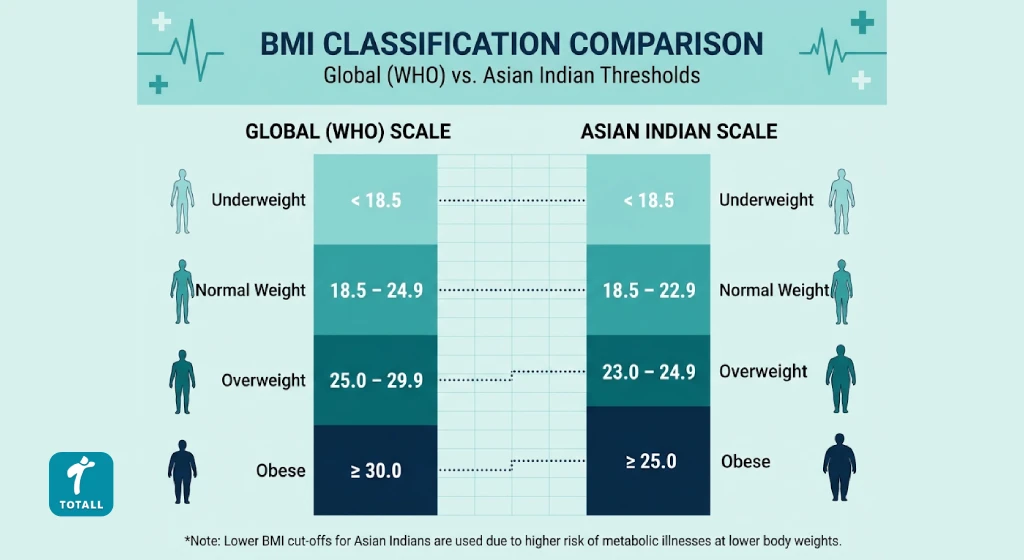
This 2009 table remains widely used for routine screening and is still referenced throughout Indian clinical guidance, but it is no longer the complete picture. A 2025 Indian consensus, led by the India Obesity Commission, moved beyond a BMI-only definition entirely. It defines Stage 1 obesity as a BMI above 23 without organ or functional impairment, and Stage 2 obesity as a BMI above 23 plus excess waist circumference or waist-to-height ratio, together with functional limitations or an obesity-related disease such as type 2 diabetes. In other words, current Indian obesity medicine is moving toward a model where the BMI number starts the conversation, but waist measurement, symptoms, and related disease determine what it actually means for an individual. The full detail on that framework is covered in the obesity guide’s classification section; the rest of this article focuses on calculating and interpreting the numbers that feed into it.
A Few Worked Examples
Numbers land better with context. Here’s how the same BMI plays out differently across a few heights, using the Indian scale:
- At 1.55 m (5’1″), a weight of 60 kg gives a BMI of about 25.0, obese on the Indian scale, overweight on the global scale.
- At 1.70 m (5’7″), a weight of 72 kg gives a BMI of about 24.9, overweight on the Indian scale, still normal on the global scale.
- At 1.80 m (5’11”), a weight of 85 kg gives a BMI of about 26.2, obese on both scales.
The middle example is the one worth sitting with. A 1.70 m person at 72 kg would be told by most global-default calculators that they’re in the healthy range. By the classification that applies to Indian metabolic risk, they’ve already crossed into overweight territory, worth a waist measurement and a conversation with a doctor, not a cause for alarm, but not “all clear” either.
How to Measure Your Waist Circumference Correctly
BMI tells you about weight relative to height; waist circumference provides an additional measure of central abdominal adiposity, a proxy for visceral fat rather than a direct measurement of it, which is strongly associated with metabolic risk. Measuring it correctly matters, because a loosely wrapped tape measure, measuring over thick clothing, or using the wrong landmark will give you a misleading number.
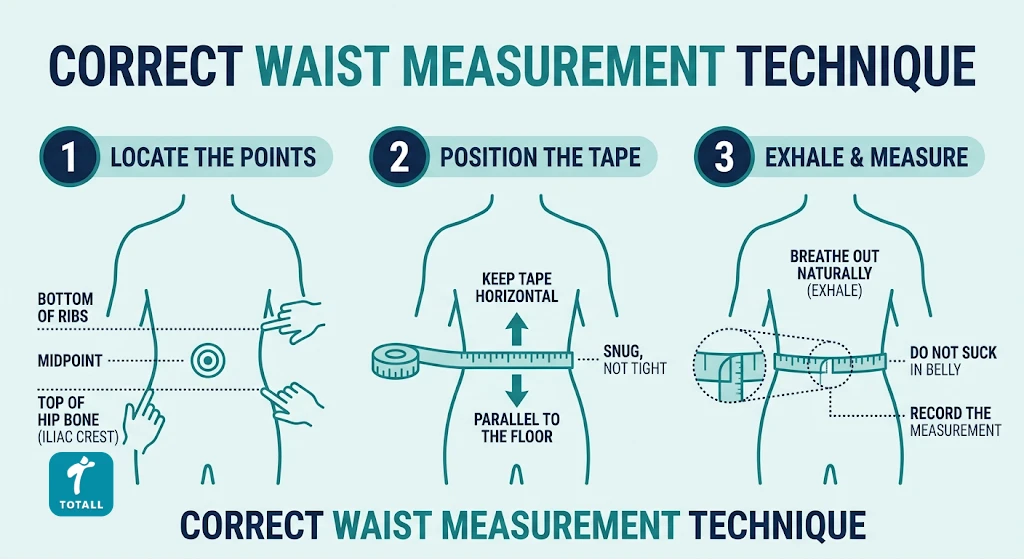
- Stand upright, feet together, and breathe out normally, don’t hold your breath or suck in your stomach.
- Locate the midpoint between the lower margin of your last palpable rib and the top of your hip bone (the iliac crest), on the side of your body, not necessarily at the narrowest point of your waist or at navel level, which is a different landmark used in some other protocols and can give a different number.
- Wrap a flexible measuring tape around this point, parallel to the floor, snug against the skin but not compressing it.
- Read the measurement at the end of a normal exhale.
- For the Asian-Indian clinical threshold, compare against 90 cm for men and 80 cm for women; a reading at or above these figures is commonly used to identify abdominal obesity and increased metabolic risk, alongside your BMI rather than as a stand-alone diagnosis.
If you’re doing this for the first time, it’s worth having someone else hold the tape level around your back while you check the reading at the front, since it’s easy to let the tape sag or twist when checking on yourself.
Waist-to-Height Ratio: A Useful Second Check
Some clinicians use waist-to-height ratio (WHtR) as an additional screen, particularly useful because it doesn’t need separate cutoffs for men and women the way waist circumference alone does. Divide your waist measurement by your height, using the same unit for both. A waist-to-height ratio above 0.5 is commonly used as a screening threshold for increased central adiposity, and it’s also the specific cutoff used in the 2025 Indian obesity staging framework described above. A person who is 165 cm tall, for instance, would want to keep their waist under roughly 82.5 cm by this measure.
Who Should Actually Get This Checked Properly
A BMI calculator and a tape measure at home are a reasonable starting point, but they’re not a diagnosis. It’s worth getting a full evaluation, rather than relying on a home calculation, if your BMI comes out at 23 or above on the Indian scale, if your waist circumference is at or near the 90/80 cm thresholds, if you have a personal history or symptoms of PCOS, a strong family history of diabetes or premature heart disease, or if you’ve noticed changes in energy, sleep, or joint comfort alongside weight gain. Book a consultation with TOTALL’s endocrine and obesity-medicine team in Indore for measurements taken properly, alongside the metabolic blood work a home calculator can’t provide.
Frequently Asked Questions
What is a healthy BMI for Indians?
Under the 2009 Asian-Indian consensus classification used in Indian clinical practice, a BMI between 18.5 and 22.9 is considered normal weight, lower than the 18.5 to 24.9 range often quoted by international calculators built on the global WHO scale. A separate 2025 Indian framework additionally considers waist measurement and health impact alongside BMI, rather than relying on BMI alone.
How do I calculate my BMI manually?
Divide your weight in kilograms by your height in metres squared. For example, a person weighing 65 kg at a height of 1.60 m would calculate 65 ÷ (1.60 × 1.60), which equals 65 ÷ 2.56, or a BMI of approximately 25.4.
Why do Indian BMI cutoffs differ from the global standard?
Research reviewed by a 2004 WHO Expert Consultation found that Asian populations, including Indians, face elevated diabetes and cardiovascular risk at lower BMI levels than the global standard assumes, generally linked to a higher percentage of body fat, particularly abdominal fat, at a given BMI. Rather than one universal Asian cutoff, WHO proposed a range of population-specific action points, and India’s own 2009 consensus statement set clinical thresholds based on this evidence.
Is BMI accurate for everyone?
No. BMI doesn’t distinguish between muscle and fat, so it can overestimate risk in very muscular individuals and underestimate it in people with low muscle mass and high body fat, sometimes called “normal weight obesity.” It also doesn’t account for age, sex-specific body composition differences, or fat distribution, which is why waist circumference is used alongside it.
What BMI is considered obese in India?
A BMI of 25 or above is classified as obese under the Asian-Indian consensus guidelines used in Indian clinical practice, compared to 30 or above under the global WHO scale.
Does BMI differ for men and women?
The BMI formula itself and the classification thresholds are the same for men and women. What differs is the waist-circumference threshold used alongside it (90 cm for men, 80 cm for women) and the fact that women, particularly after their thirties, show higher rates of abdominal obesity in Indian population data even at a similar BMI to men.
Sources
- Misra A, Chowbey P, Makkar BM, et al. — Consensus Statement for Diagnosis of Obesity, Abdominal Obesity and the Metabolic Syndrome for Asian Indians, Journal of the Association of Physicians of India, 2009
- Misra A, Vikram NK, Ghosh A, et al.; India Obesity Commission — Revised definition of obesity in Asian Indians living in India, Diabetes & Metabolic Syndrome: Clinical Research & Reviews, 2025
- WHO Expert Consultation — Appropriate body-mass index for Asian populations and its implications for policy and intervention strategies, The Lancet, 2004 (identified general Asian public-health action points; did not itself establish the Indian-specific 23/25 thresholds above)
- World Health Organization — Obesity and overweight fact sheet (global 25/30 classification)
- TOTALL — Complete guide to Obesity: Causes, Symptoms, Types and Treatment in India