Medically reviewed by the endocrine and obesity-medicine team at TOTALL Diabetes Hormone Institute, Indore.
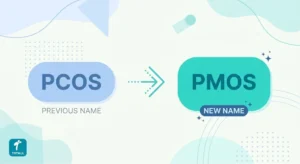
If you’ve searched for PCOS recently and come across the term PMOS, you haven’t stumbled onto a typo or a rumour. In May 2026, the condition long known as polycystic ovary syndrome (PCOS) was formally renamed polyendocrine metabolic ovarian syndrome (PMOS), through a global consensus process published in The Lancet and backed by more than fifty patient and professional organisations, including the Endocrine Society and the American Society for Reproductive Medicine. This guide covers what that name change actually means, alongside the practical questions people ask most: the real symptoms, how it’s actually diagnosed, when it typically starts, and whether it’s something you can test for at home.
Table of Contents
- 1. PCOS Is Now Called PMOS: What Changed and Why
- 2. What Was PCOS Originally Called?
- 3. The 5 Core Symptoms of PCOS (PMOS)
- 4. The Very First Signs, Before a Diagnosis
- 5. At What Age Does PCOS (PMOS) Start?
- 6. How PCOS (PMOS) Is Actually Diagnosed
- 7. Can You Test for PCOS at Home?
- 8. Is There a “PCOS Stage 1”? Clearing Up a Common Myth
- 9. Can You Live a Normal Life With PCOS (PMOS)?
- 10. Can Someone With PCOS Get Pregnant?
- 11. Public Figures Who’ve Spoken Openly About PCOS
- 12. पीसीओएस और पीएमओएस: हिंदी में सामान्य प्रश्न (Hindi FAQs)
- 13. Frequently Asked Questions
- 14. Conclusion
1. PCOS Is Now Called PMOS: What Changed and Why
On 12 May 2026, a paper in The Lancet announced the outcome of an eleven-year global consensus process: polycystic ovary syndrome would officially be renamed polyendocrine metabolic ovarian syndrome, or PMOS. The process involved more than 22,000 survey responses from patients and health professionals across every world region, led by Professor Helena Teede of Monash University alongside the International Androgen Excess and PCOS Society. The Endocrine Society, the American Society for Reproductive Medicine, and dozens of other professional and patient organisations have since formally adopted the new name, with a three-year transition period underway to bring clinical practice, research and public communication in line with it.
The reasoning behind the change is straightforward. “Polycystic ovary syndrome” implies the condition is defined by cysts on the ovaries, but the small structures seen on ultrasound are actually immature follicles, not pathological cysts. The old name also put the focus entirely on the ovaries and reproduction, when the condition is really a broader hormonal and metabolic disorder that affects weight, skin, mental health, and long-term risk for diabetes and heart disease, not just fertility. Doctors and patient groups have long argued this narrow framing contributed to delayed diagnosis, fragmented care split across different specialists, and unnecessary stigma. PMOS is intended to reflect that fuller picture.
Practically, this is not a different condition, a new diagnosis, or a change in how it’s treated. If you were diagnosed with PCOS, you have PMOS. The symptoms, the diagnostic approach, and the treatment options are unchanged; only the name and the framing around it have shifted. Because PCOS remains the far more widely recognised term while this transition is still underway, this article and most current medical literature use both terms together.
2. What Was PCOS Originally Called?
Before it was known as PCOS, the condition was first described nearly a century ago, when surgeons operating on a patient noticed small sac-like structures on her ovaries alongside high male-hormone levels and difficulty conceiving. It was initially called Stein-Leventhal syndrome, after the two doctors who first documented it in the 1930s, before the name shifted to polycystic ovary syndrome as the condition became better understood. The 2026 rename to PMOS is the most significant naming change since that shift, and the first one driven by a large-scale, patient-inclusive global consensus process rather than a single medical team.
3. The 5 Core Symptoms of PCOS (PMOS)
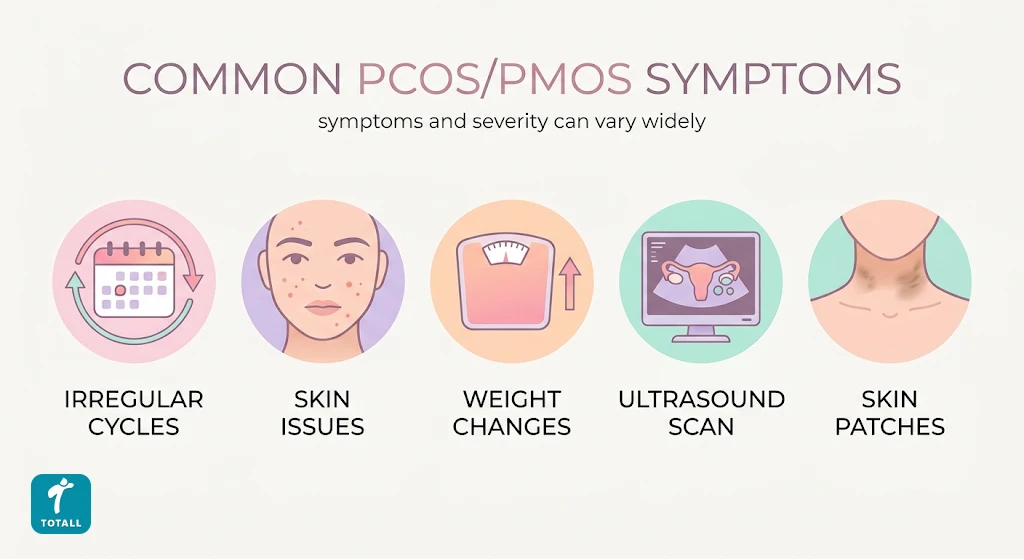
Not everyone with PCOS has every symptom, and severity varies significantly between individuals, but five signs come up most consistently:
- Irregular or absent periods. Cycles that are unpredictable, infrequent, unusually long, or that stop altogether, caused by irregular or absent ovulation.
- Excess androgen effects. Higher-than-typical levels of male hormones (androgens) can cause acne, particularly along the jawline and chin, excess facial or body hair growth (hirsutism), and thinning hair on the scalp.
- Weight gain, particularly around the abdomen. Many people with PCOS find weight gathers more around the midsection and is harder to lose than expected, linked to underlying insulin resistance.
- Polycystic-appearing ovaries on ultrasound. Ovaries that appear enlarged and contain multiple small, immature follicles, visible on a transvaginal or pelvic ultrasound. This finding alone does not mean someone has PCOS; it’s one of three diagnostic criteria, not proof by itself.
- Signs of insulin resistance. Skin changes such as dark, velvety patches (acanthosis nigricans), typically at the neck or underarms, along with fatigue and strong sugar cravings, often point to the insulin resistance that underlies much of the condition.
Beyond these five, many people also experience mood changes, sleep disturbances, and skin tags, and the condition is closely linked to fatty liver disease and future type 2 diabetes risk. Our related guide on semaglutide for PCOS, fatty liver and insulin resistance covers that metabolic connection in depth.
4. The Very First Signs, Before a Diagnosis
For most people, the earliest signs appear around puberty, often as stubborn acne that doesn’t respond to typical skincare, or periods that never quite settle into a predictable pattern the way they’re expected to a year or two after menarche. These early signs are frequently dismissed, by patients and sometimes by doctors, as normal teenage hormonal fluctuation, which is a major reason diagnosis is often delayed by several years. Persistent, worsening acne combined with irregular cycles in the teenage years is worth raising with a doctor specifically, rather than assuming it will resolve on its own.
5. At What Age Does PCOS (PMOS) Start?
PCOS most commonly becomes apparent around puberty, typically in the early-to-mid teenage years, since it’s fundamentally a hormonal condition tied to the reproductive system’s maturation. However, diagnosis often happens later, sometimes not until someone in their twenties or thirties struggles with fertility or notices worsening metabolic symptoms, because earlier signs were attributed to other causes. The underlying hormonal tendency is generally present from puberty even when the formal diagnosis comes years afterward.
6. How PCOS (PMOS) Is Actually Diagnosed
The most widely used diagnostic framework, known as the Rotterdam criteria, requires at least two of the following three findings, after other conditions with similar symptoms have been ruled out:
- Irregular or absent ovulation, usually identified through irregular or absent periods
- Clinical or blood-test evidence of excess androgens, either visible signs like acne and excess hair growth, or elevated androgen levels on a blood test
- Polycystic-appearing ovaries on ultrasound
This means a normal ultrasound does not rule out PCOS, and having ovaries that look polycystic on a scan does not confirm it either, both of the other criteria need to be properly assessed too. A full diagnostic workup typically includes a detailed menstrual and symptom history, blood tests for androgen levels and to rule out thyroid or other hormonal conditions that mimic PCOS, and a pelvic ultrasound. This is why an accurate diagnosis generally requires a doctor, rather than a single test or scan on its own.
7. Can You Test for PCOS at Home?
There is no reliable at-home test that can diagnose PCOS on its own. Ovulation predictor kits, period-tracking apps, and at-home hormone test kits can help you notice patterns worth mentioning to a doctor, irregular cycle length, signs of anovulation, or unusually high or low readings, but none of them replace the blood tests and ultrasound needed for an actual diagnosis. If a symptom tracker or home kit is raising a concern, the right next step is booking a proper evaluation, not relying on the home result as a diagnosis in itself.
8. Is There a “PCOS Stage 1”? Clearing Up a Common Myth
PCOS does not have an official numbered staging system the way some other conditions do. There’s no medically recognised “stage 1,” “stage 2,” and so on. What does exist are four recognised phenotypes, based on which combination of the three Rotterdam criteria a person meets, sometimes informally labelled A through D by clinicians. Phenotype A, meeting all three criteria, tends to be associated with more pronounced metabolic effects, while phenotypes involving fewer criteria tend to present more mildly, though this varies by individual. If you’ve seen “PCOS stage 1” referenced online, it’s most likely a misunderstanding of this phenotype system rather than an official medical classification, and it’s worth asking your doctor directly which phenotype pattern applies to your case rather than looking for a numbered stage.
9. Can You Live a Normal Life With PCOS (PMOS)?

Yes. PCOS is a manageable, long-term condition, not a barrier to a normal life, though it does typically require ongoing attention rather than a one-time fix. With appropriate management, lifestyle adjustments around diet and activity, treatment of specific symptoms like acne or excess hair growth, and monitoring for related risks like insulin resistance and fatty liver disease, most people with PCOS lead full, healthy lives, including having children when that’s a goal. The condition tends to need more consistent long-term attention than a typical short-course illness, but “manageable” is a much more accurate description than “life-limiting.”
10. Can Someone With PCOS Get Pregnant?
Yes, though PCOS is one of the most common causes of ovulation-related fertility difficulty, since irregular or absent ovulation directly affects the ability to conceive naturally each cycle. Many people with PCOS do conceive without medical assistance, particularly with management of weight and insulin resistance where relevant, and for those who need support, treatments ranging from ovulation-inducing medication to assisted reproductive techniques have well-established track records specifically for PCOS-related infertility. A PCOS diagnosis is a reason to plan proactively with a doctor if pregnancy is a goal, not a reason to assume it won’t be possible.
11. Public Figures Who’ve Spoken Openly About PCOS
Public figures sharing their own PCOS experiences has done a lot to reduce the stigma around a condition many people historically felt uncomfortable discussing. Sara Tendulkar has spoken publicly, in a Vogue India interview, about her own PCOS diagnosis as a teenager and how persistent acne was her earliest sign, along with the lifestyle changes, weight training and a protein-focused diet, that helped her manage it. Her account reflects a pattern common to many PCOS stories: symptoms dismissed early as ordinary teenage skin issues, followed by a proper diagnosis once the pattern became clear. Sharing these experiences publicly has helped many people recognise similar signs in themselves sooner.
12. पीसीओएस और पीएमओएस: हिंदी में सामान्य प्रश्न
पीएमओएस का क्या मतलब है?
मई 2026 में, पीसीओएस (पॉलीसिस्टिक ओवरी सिंड्रोम) का नाम बदलकर पीएमओएस (पॉलीएंडोक्राइन मेटाबॉलिक ओवेरियन सिंड्रोम) कर दिया गया। यह वही स्थिति है, केवल नाम बदला गया है ताकि यह बीमारी के हार्मोनल और मेटाबॉलिक पहलुओं को बेहतर तरीके से दर्शाए।
पीसीओएस के 5 लक्षण क्या हैं?
अनियमित या रुके हुए मासिक धर्म, अतिरिक्त पुरुष हार्मोन के प्रभाव (जैसे मुंहासे और अत्यधिक बाल उगना), पेट के आसपास वजन बढ़ना, अल्ट्रासाउंड में पॉलीसिस्टिक दिखने वाले अंडाशय, और इंसुलिन प्रतिरोध के संकेत (जैसे गर्दन पर काली त्वचा) मुख्य लक्षण हैं।
PCOS दर्द कहाँ स्थित है?
पीसीओएस से जुड़ा दर्द आमतौर पर निचले पेट या पेल्विक क्षेत्र में महसूस होता है, अक्सर मासिक धर्म के दौरान या अंडाशय में सूजन के कारण। यह दर्द हर व्यक्ति में अलग-अलग हो सकता है, और लगातार या गंभीर दर्द के लिए डॉक्टर से सलाह लेना जरूरी है।
पीसीओएस के लक्षण कैसे शुरू होते हैं?
ज्यादातर मामलों में, शुरुआती लक्षण किशोरावस्था में दिखाई देते हैं, आमतौर पर लगातार मुंहासों और अनियमित मासिक धर्म चक्र के रूप में। इन्हें अक्सर सामान्य किशोर हार्मोनल बदलाव समझकर नज़रअंदाज़ कर दिया जाता है।
क्या पीसीओएस लड़की गर्भवती हो सकती है?
हां, पीसीओएस होने पर भी गर्भवती होना संभव है, हालांकि अनियमित ओव्यूलेशन के कारण यह थोड़ा कठिन हो सकता है। सही चिकित्सा सहायता और वजन एवं इंसुलिन प्रतिरोध के प्रबंधन से कई महिलाएं सफलतापूर्वक गर्भधारण करती हैं।
13. Frequently Asked Questions
Is PCOS being renamed in 2026?
Yes, this has already happened. On 12 May 2026, PCOS was officially renamed polyendocrine metabolic ovarian syndrome (PMOS) through a global consensus process published in The Lancet, with a three-year transition period now underway across clinical practice and research.
Is there any difference between PCOS and PMOS?
No. PMOS is simply the new name for the exact same condition previously called PCOS. The diagnostic criteria, symptoms, and treatment approaches are unchanged.
Why is PCOS now called PMOS?
The old name implied the condition was defined by ovarian cysts, which is inaccurate, and it focused attention narrowly on the ovaries and fertility, when the condition affects hormones, metabolism, skin and long-term health more broadly. The rename followed an eleven-year, patient-inclusive global consensus process.
What is PCOS stage 1?
There is no official numbered staging system for PCOS. This term is most likely a misunderstanding of the four recognised phenotypes (A through D), which classify cases based on which diagnostic criteria are met, not a formal stage.
Can I test for PCOS at home?
Not definitively. Home ovulation kits and symptom trackers can help you notice patterns worth discussing with a doctor, but a proper diagnosis requires blood tests and an ultrasound, which can’t be replicated at home.
Can I live a normal life with PCOS?
Yes. With appropriate long-term management of symptoms and related metabolic risks, most people with PCOS live full, healthy lives, including having children when that’s a goal.
14. Conclusion
PCOS, now formally PMOS, is common, well understood by modern medicine, and manageable, even though the condition itself and the recent name change can both feel confusing at first. Recognising the real early signs, understanding that diagnosis needs more than a single scan or symptom, and knowing that a normal life, including pregnancy, is genuinely achievable with proper management, are the most useful things to take from this. If insulin resistance, fatty liver, or weight are part of your picture alongside PCOS, our guide on semaglutide for PCOS, fatty liver and insulin resistance covers that connection in more depth.
For a proper evaluation, or to discuss symptoms you’ve noticed, book a consultation with TOTALL’s hormone and endocrine specialists in Indore, explore our Hormonal Treatment services, or call +91 731 244 3344.