Medically reviewed by the endocrine and obesity-medicine team at TOTALL Diabetes Hormone Institute, Indore. Last updated July 2026.
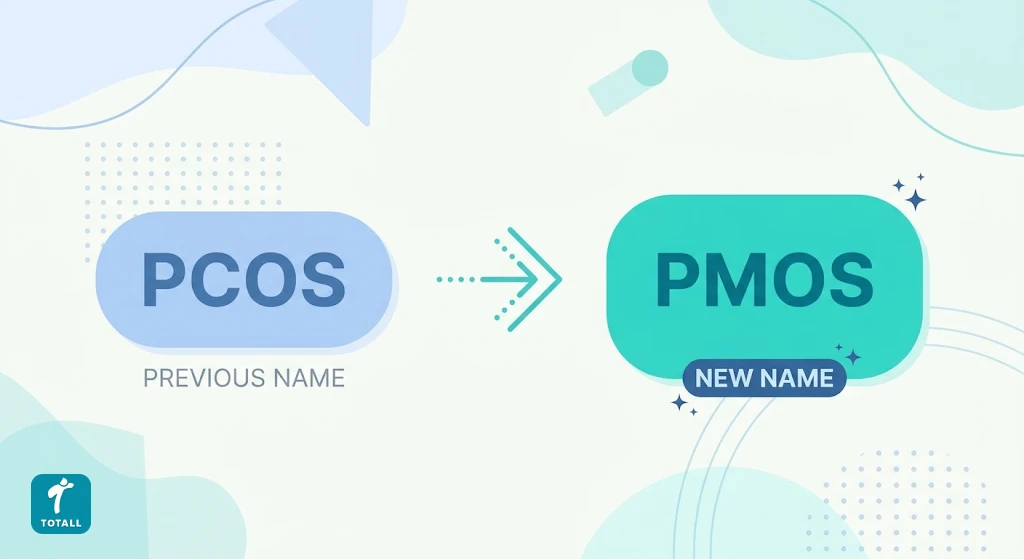
If you’ve seen the term PMOS appear where PCOS used to be, either in a news headline, on a health app, or in something a doctor said, you’re not imagining things and you haven’t missed a diagnosis. PMOS is the new official name for the condition previously known as polycystic ovary syndrome. Here’s exactly what changed, why it changed, and what genuinely stays the same.
Table of Contents
- 1. Quick Answer
- 2. What Does PMOS Actually Stand For?
- 3. Is PMOS the Same Condition as PCOS?
- 4. Who Decided This, and How?
- 5. Why the Old Name Was Considered a Problem
- 6. Breaking Down the Three New Words
- 7. When Did This Become Official?
- 8. What Actually Changes, and What Doesn’t
- 9. How Long Will the Transition Take?
- 10. Frequently Asked Questions
- 11. Conclusion
1. Quick Answer
PMOS stands for polyendocrine metabolic ovarian syndrome. It is the new name for polycystic ovary syndrome (PCOS), officially adopted in May 2026 following an eleven-to-fourteen-year global consensus process involving more than 22,000 patients and health professionals. If you were diagnosed with PCOS, you have PMOS. It is the same condition, with the same symptoms and the same treatment approach, described with a name that better reflects what the condition actually involves.
2. What Does PMOS Actually Stand For?
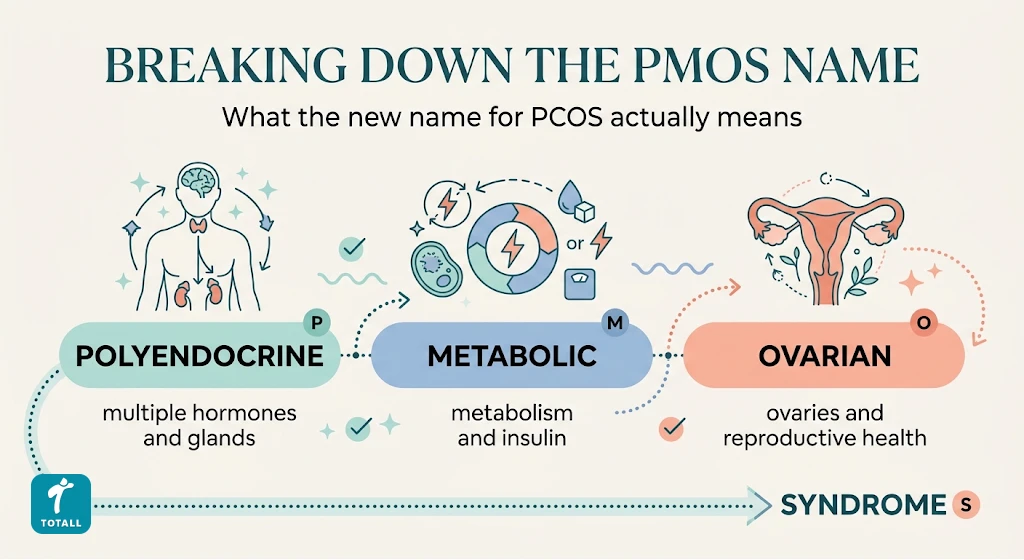
PMOS stands for Polyendocrine Metabolic Ovarian Syndrome. Each word was chosen deliberately to capture a part of the condition the old name left out:
- Polyendocrine reflects that multiple hormone systems are involved, not just reproductive hormones.
- Metabolic acknowledges the central role of insulin resistance and broader metabolic dysfunction, which affects weight, blood sugar, and long-term diabetes and heart disease risk.
- Ovarian syndrome keeps the ovarian and menstrual cycle aspects of the condition in the name, since they remain genuinely important, without suggesting they’re the whole story.
3. Is PMOS the Same Condition as PCOS?
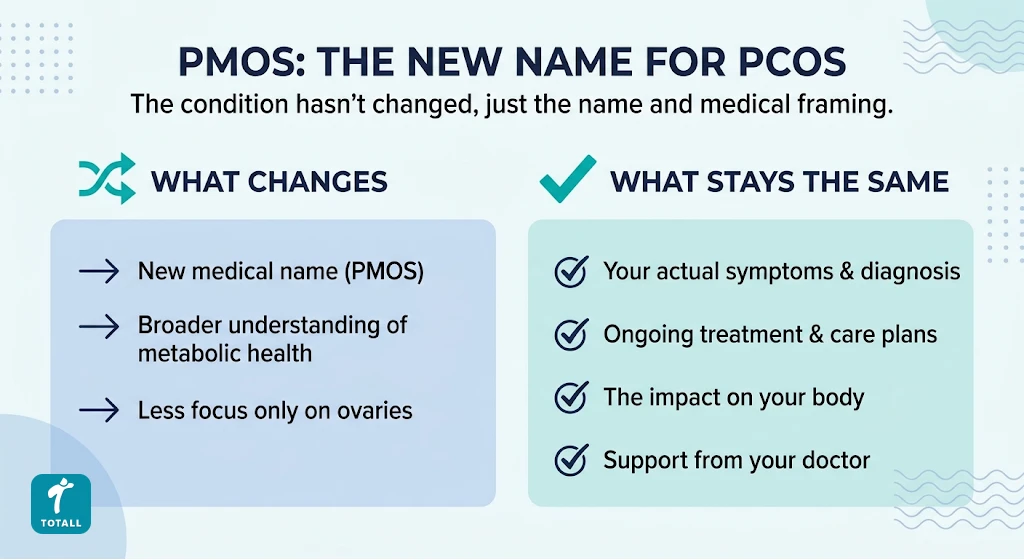
Yes, completely. This is worth stating plainly because the headlines around this change can sound bigger than the actual clinical reality. Nothing about your body, your diagnosis, your symptoms, or your risk profile is different than it was before the name changed. What changed is the label and the framing around it, not the underlying condition. A reproductive endocrinologist at Yale Medicine who contributed to the consensus process described it as moving from a “microscopic” view of the condition to a “telescopic” one, same underlying reality, wider lens.
4. Who Decided This, and How?
The rename wasn’t announced by a single hospital or company. It came out of a formal global consensus process led by Professor Helena Teede at Monash University in Australia, working with the International Androgen Excess and PCOS Society. The process ran for well over a decade and gathered survey responses from more than 22,000 patients and multidisciplinary health professionals across every world region, using structured methods designed to build genuine consensus rather than a top-down decision. More than fifty patient and professional organisations, including the Endocrine Society and the American Society for Reproductive Medicine, formally endorsed the outcome. It’s been described as the largest medical renaming effort ever undertaken.
5. Why the Old Name Was Considered a Problem
“Polycystic ovary syndrome” implied the condition was defined by cysts on the ovaries. In reality, the small structures seen on an ultrasound in PCOS are immature follicles, not pathological cysts in the way the word usually gets understood. This created two real, documented problems. First, people were sometimes told they couldn’t have PCOS because their ovaries “looked normal” on a scan, which is medically inaccurate but happened often enough to meaningfully delay diagnosis. Current estimates suggest the condition remains underdiagnosed in up to 70 percent of people who have it. Second, the name focused attention narrowly on the ovaries and fertility, when the condition’s biggest long-term impact for many people is metabolic, insulin resistance, weight, fatty liver risk, and cardiovascular risk, alongside skin, hair and mental health effects that have nothing to do with fertility at all.
6. Breaking Down the Three New Words
| Word | What It Signals |
|---|---|
| Polyendocrine | The condition involves multiple hormone-producing systems working together, not a single isolated ovarian issue |
| Metabolic | Insulin resistance and its downstream effects, weight, blood sugar, liver fat, are core to the condition, not a side effect of it |
| Ovarian Syndrome | Menstrual cycle changes and ovarian findings are still a genuine part of the picture, just not the entire definition |
7. When Did This Become Official?
The consensus paper was published in The Lancet on 12 May 2026 and presented at the European Congress of Endocrinology in Prague the same week. Major bodies including the Endocrine Society, Johns Hopkins Medicine, and the American Society for Reproductive Medicine had adopted and published guidance using the new name within weeks of the announcement.
8. What Actually Changes, and What Doesn’t
| Stays the Same | Changes |
|---|---|
| The condition itself and who has it | The name used to describe it |
| Current diagnostic criteria (Rotterdam criteria, unchanged for now) | How clinicians and researchers are encouraged to frame and discuss the condition |
| Treatment approaches already in use | Terminology in new research, education materials, and gradually, clinical practice |
| What appears on existing prescriptions, insurance forms, and medical records for the foreseeable future | Public awareness campaigns and patient-facing materials, which are being updated over a multi-year transition |
Experts have been explicit that whether current diagnostic criteria fully capture the condition as it’s now understood remains a separate, ongoing question, under review but not yet resolved. The name change and any future criteria changes are related but distinct processes.
9. How Long Will the Transition Take?
Official guidance from multiple institutions describes a three-year transition period for adoption across clinical practice, research, education, and public communication. In practice, this means both terms, PCOS and PMOS, will be used interchangeably in medical settings, patient materials, and search results for at least the next few years, with PCOS likely remaining the more recognised term for some time simply because of how long it’s been in use.
10. Frequently Asked Questions
Is PCOS being renamed in 2026?
Yes, this already happened. The rename to PMOS became official with a paper published in The Lancet on 12 May 2026, backed by a global consensus of patients, clinicians and professional organisations.
Is there any difference between PCOS and PMOS?
No clinical difference. PMOS is the new name for the exact same condition previously called PCOS. If you were diagnosed with PCOS, that diagnosis is now referred to as PMOS.
Why is PCOS now called PMOS?
The old name implied the condition was defined by ovarian cysts, which is inaccurate, and framed it too narrowly around fertility. PMOS better reflects that it’s a broader hormonal and metabolic condition, and the rename followed a fourteen-year, patient-inclusive global consensus process.
What was PCOS originally called?
Before it was known as PCOS, the condition was first described in the 1930s and initially called Stein-Leventhal syndrome, after the two doctors who documented it.
Will my medical records still say PCOS?
Yes, for now. Experts have said patients should expect to see PCOS on prescriptions, insurance paperwork, and medical records for the foreseeable future, since the transition to PMOS across all systems will take time.
11. Conclusion
PMOS is not a new diagnosis, a new condition, or a reason to worry that something about your health has changed. It’s a renaming, backed by an unusually large and genuinely patient-inclusive global process, intended to fix decades of confusion caused by a name that never quite described the condition accurately. If you’re wondering what this means for your own diagnosis or treatment plan specifically, that’s covered in detail in our follow-up guide, and our full PCOS (PMOS) symptoms and diagnosis guide covers the practical side: signs, testing, and living with the condition.
To discuss your own symptoms or diagnosis, book a consultation with TOTALL’s hormone and endocrine specialists in Indore, or call +91 9302443344.