Medically reviewed by TOTALL Diabetes Hormone Institute, Indore.
Search “best diet for weight loss” and you’ll find keto, intermittent fasting, high-protein, low-carb, and a dozen other approaches, each with a claim to being the one true answer. The evidence doesn’t actually support any single winner. What it supports is less exciting to sell but more useful to know: a sustainable calorie deficit, adequate protein, and a diet you can actually maintain outperform any specific macronutrient formula in the long run. This guide covers what the evidence actually says, what India’s own official dietary guidelines recommend, and where a lot of popular Indian weight-loss advice goes wrong. For the wider picture of obesity and its full range of treatment options, see our main obesity guide; this article focuses specifically on diet.
What Actually Drives Weight Loss
Weight loss, at the physiological level, requires consistently consuming fewer calories than the body uses. Every legitimate dietary approach that produces weight loss, whether it’s built around cutting carbohydrates, cutting fat, intermittent fasting windows, or simple portion control, works because it creates that deficit, directly or indirectly. This isn’t a controversial or oversimplified claim; it’s the consistent finding across decades of comparative diet trials. When researchers control for calorie intake and protein adequacy, different macronutrient splits (low-carb versus low-fat, for instance) tend to produce broadly similar weight loss on average, with individual variation explained more by adherence, meaning how consistently someone actually followed the plan, than by which specific diet they followed.
That’s not an argument that all diets are equally good in practice. It’s an argument for choosing an approach you can sustain for months, not weeks, over one that promises faster results through more extreme restriction. The diet that works is the one a person can actually keep doing.
India’s Official Guidance: The ICMR-NIN “My Plate for the Day”
India has its own evidence-based dietary framework, and it’s worth building around this rather than an imported Western template, since it’s specifically calibrated to Indian eating patterns and nutrient gaps. The Indian Council of Medical Research and National Institute of Nutrition released revised Dietary Guidelines for Indians in May 2024, the first major update since 2011. The centrepiece is the “My Plate for the Day” model: for a reference 2,000 kcal daily intake, it recommends roughly 400 grams of vegetables, 100 grams of fruit, 250 grams of cereals and millets, 85 grams of pulses, eggs, or other protein-rich foods, 35 grams of nuts and seeds, and 27 grams of fat and oil, drawn across a minimum of eight distinct food groups rather than the four the 2011 guidelines used.
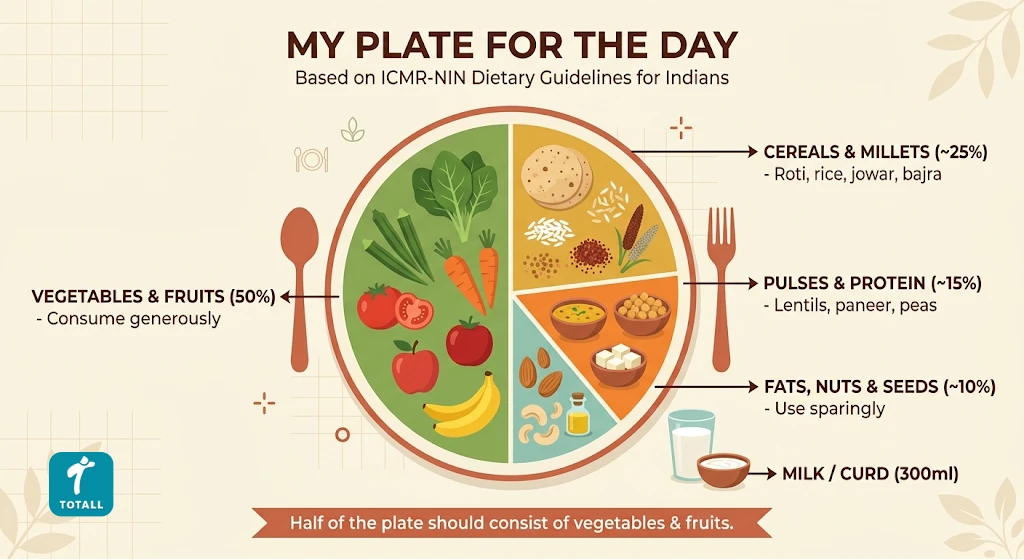
Two specific recommendations are worth calling out because they run against how most Indians actually eat. First, cereals and refined grains shouldn’t contribute more than 45 percent of total daily energy, but the guidelines note actual intake commonly runs to 50 to 70 percent in Indian diets, meaning the average plate is more rice-or-roti-heavy and less vegetable-and-protein-heavy than is optimal. Second, at least 20 to 30 percent of the cereal portion (by raw weight) should come from millets such as ragi, jowar, and bajra rather than polished rice and refined wheat, since millets carry a lower glycaemic impact and meaningfully more fibre and micronutrients.
The Protein Gap, Especially for Vegetarians
A basic reference intake is around 0.8 grams of protein per kilogram of body weight per day, though needs run higher during active weight loss to help preserve muscle mass. This matters more in India than the number alone suggests: ICMR research has found that a large share of Indian households derive 60 to 75 percent of their protein from cereals rather than more protein-dense sources like pulses, dairy, eggs, or meat, which tends to leave actual protein intake below what’s needed even when total food intake looks adequate. For vegetarian and vegan diets specifically, practical protein sources include dal and other pulses, paneer, curd and milk, soy products like tofu and soya chunks, and a variety of pulses and legumes rotated through the week rather than relying on one source; for non-vegetarians, eggs, fish, and lean meat can substitute for part of the pulses portion. Getting this right is one of the more overlooked levers in Indian weight-loss diets, since adequate protein supports satiety and helps preserve muscle during a calorie deficit, which matters for long-term metabolic health, not just the number on the scale.
Common Indian Diet Myths Worth Retiring
| Myth | What the evidence actually supports |
|---|---|
| Cutting out rice or roti entirely is necessary to lose weight. | Portion and overall calorie balance matter more than eliminating a specific staple. A moderate portion of rice or roti alongside adequate protein and vegetables fits within a normal weight-loss plan; total elimination isn’t necessary for most people and is harder to sustain. |
| Skipping meals speeds up weight loss. | Skipping meals often leads to overeating later and can make it harder to hit protein targets across the day. Consistent meal timing tends to be easier to sustain than skipping. |
| All-liquid “detox” diets and juice cleanses clear out toxins and burn fat fast. | The body doesn’t require a special diet to “detox,” that’s the liver and kidneys’ ongoing job. Juice-only diets are typically low in protein and fibre, which makes them hard to sustain and can mean any early weight loss is water and muscle, not primarily fat. |
| Ghee and oil should be eliminated completely. | Fat is a required nutrient, and India’s own guidelines allocate a specific daily amount (around 27 grams at a 2,000 kcal intake) rather than zero. Moderation, not elimination, is the guidance. |
| Fast weight loss (multiple kilos a week) is the sign of a good diet. | Sustainable weight loss is generally in the range of 0.5 to 1 kg per week for most adults. Faster loss usually means more muscle and water loss alongside fat, and is harder to maintain. |
A Realistic Pace, and What a Day Can Actually Look Like
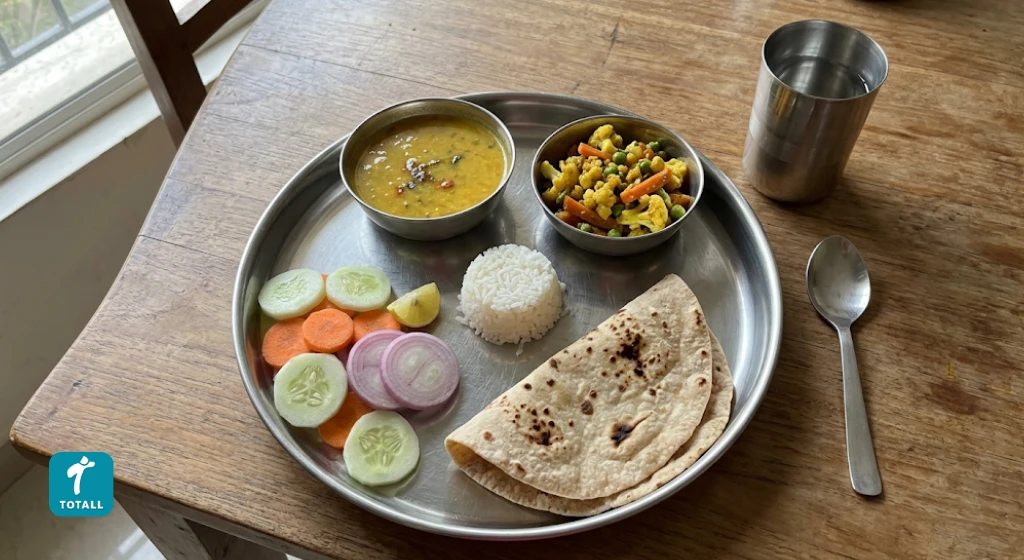
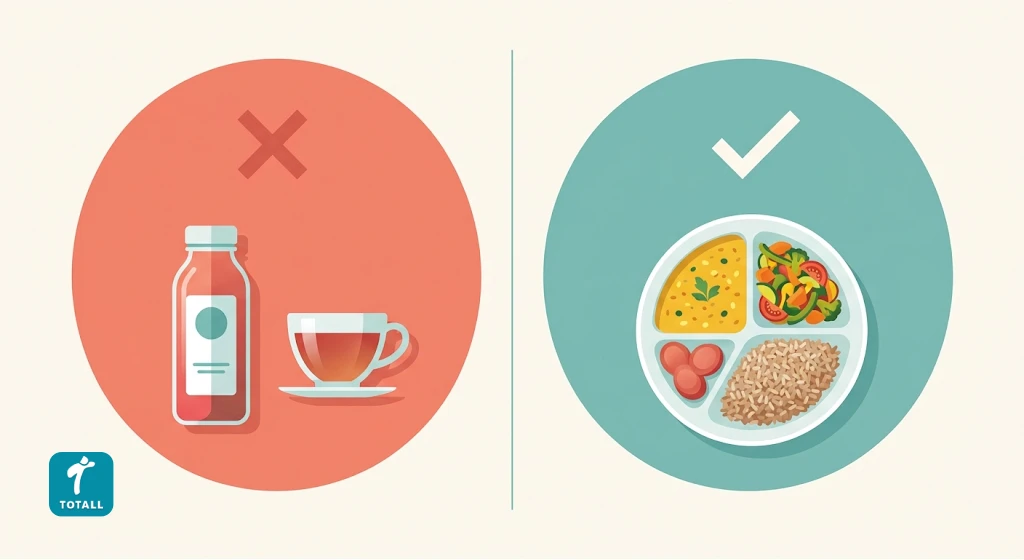
Most adults can sustainably lose roughly 0.5 to 1 kg per week through a moderate calorie deficit, and traditional Indian meal structures already map reasonably well onto the ICMR “My Plate” model once portions are adjusted: dal or another pulse and a curd or paneer side cover the protein portion, a generous serving of sabzi and salad covers the vegetable half, and a moderate portion of roti or rice, ideally including some millet rotation, covers the grain quarter. What tends to derail this in practice isn’t the core structure of an Indian meal, it’s what surrounds it: excess oil from deep frying, sugar-heavy tea and mithai eaten as habit rather than occasion, and ultra-processed snacks like packaged namkeen and biscuits, which the 2024 guidelines specifically flag as an area of rising concern in Indian diets.
When Generic Advice Isn’t Enough
This guide covers general principles, not an individualised plan, and that distinction matters more for some people than others. A structured, personalised dietary plan from a dietitian is particularly worth pursuing if you have diabetes or prediabetes, PCOS/PMOS (covered in more detail in TOTALL’s guide to obesity and PCOS), a thyroid condition, or if previous unsupervised attempts haven’t produced lasting results. Book a consultation with TOTALL’s team in Indore for nutrition planning that accounts for your specific metabolic picture rather than a generic template.
Frequently Asked Questions
What is the best diet for weight loss?
There is no single best diet backed by strong evidence over all others. What consistently predicts success is a sustainable calorie deficit, adequate protein, and an eating pattern a person can maintain for months, not just weeks. India’s own ICMR-NIN “My Plate for the Day” guidelines provide a practical, evidence-based structure built around Indian food patterns.
How many calories should I eat to lose weight?
This depends on individual factors including current weight, activity level, age, and sex, so a generic number isn’t reliable. ICMR-NIN guidelines use 2,000 kcal as a reference figure for a sedentary adult, but an individualised target from a dietitian, accounting for your specific situation, is more useful than a one-size-fits-all number.
Is rice bad for weight loss?
No single food is inherently bad for weight loss; total calorie balance and portion size matter more than eliminating any one staple. ICMR-NIN guidelines recommend that cereals, including rice, make up no more than 45 percent of daily calories and suggest rotating in some millets, rather than eliminating rice entirely.
How much protein do I need for weight loss on a vegetarian diet?
A general reference intake is around 0.8 grams per kilogram of body weight daily, often higher during active weight loss. Vegetarian sources include dal and other pulses, paneer, curd, milk, and soy products like tofu; rotating between multiple sources helps meet both quantity and quality of protein intake.
How much weight loss per week is healthy?
Roughly 0.5 to 1 kg per week is considered a sustainable pace for most adults. Faster loss often reflects water and muscle loss rather than fat loss specifically, and tends to be harder to maintain long-term.
Do I need to avoid ghee and oil completely to lose weight?
No. Fat is an essential part of a balanced diet; India’s own dietary guidelines allocate a specific daily amount rather than recommending elimination. Moderating quantity, rather than removing fat entirely, is the evidence-based approach.
Sources
- ICMR – National Institute of Nutrition — Dietary Guidelines for Indians, 2024 edition
- Dietary guidelines across different countries and comparisons to dietary guidelines for Indians, 2024, Indian Journal of Medical Research
- TOTALL — Complete guide to Obesity: Causes, Symptoms, Types and Treatment in India