

Part of TOTALL’s complete Semaglutide Guide. Medically reviewed by the endocrine and obesity-medicine team at TOTALL Diabetes Hormone Institute, Indore. Last updated July 2026.
Starting semaglutide is an adjustment process, not simply a matter of taking the first dose and waiting for the medicine to work. Appetite may change, meals may feel different, bowel habits can shift, and some people experience temporary nausea or other gastrointestinal symptoms while the body gets used to the medicine. These changes are particularly common during dose escalation and usually become easier to manage as the body adapts to the current dose.
This guide explains what commonly happens during the early adjustment period, what may happen again after a dose increase, how long common gastrointestinal changes tend to last, and which symptoms deserve prompt medical attention.
Table of Contents
- 1. Why the Timing of Changes Matters
- 2. Week 1: What to Expect After Your First Dose
- 3. Weeks 2 to 4: Getting Used to the Starting Dose
- 4. What Happens After a Dose Increase
- 5. Months 2 to 3: What Usually Settles
- 6. Months 4 Onward: Life on a Stable Dose
- 7. Semaglutide Adjustment Timeline at a Glance
- 8. When a Symptom Is More Than Normal Adjustment
- 9. Why the Adjustment Experience Differs Between People
- 10. A Simple Way to Track Your Adjustment
- 11. Frequently Asked Questions
- 12. Conclusion
1. Why the Timing of Changes Matters
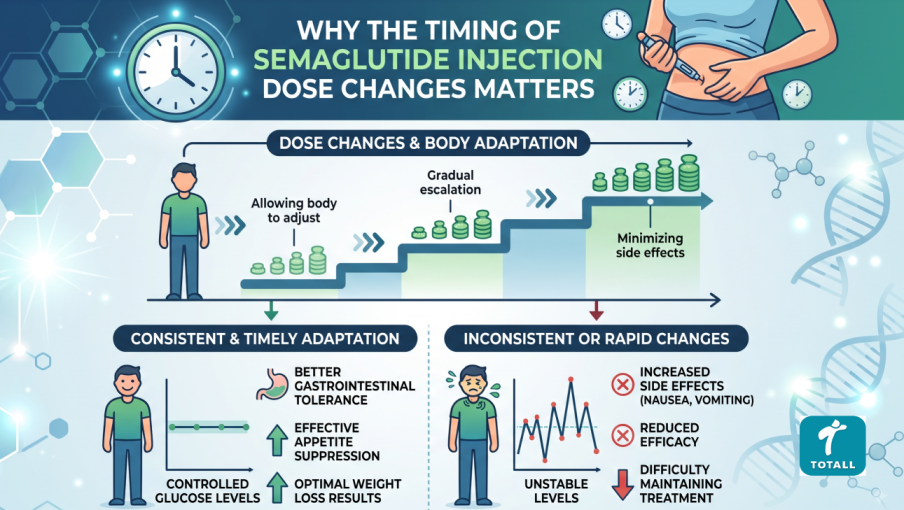
Semaglutide changes several aspects of appetite and digestion. It can reduce appetite, increase feelings of fullness and slow gastric emptying. Because the body needs time to adapt to these effects, the experience during the first few weeks can be different from what you feel after several months on a stable dose.
Clinical trials of semaglutide have consistently found that gastrointestinal changes such as nausea, diarrhoea, vomiting and constipation are reported most often during dose escalation. In pooled STEP trial data, nausea, diarrhoea and vomiting generally peaked around the dose-escalation period and declined afterward. Most gastrointestinal events were mild to moderate and temporary. :contentReference[oaicite:3]{index=3}
This means that when a symptom appears is useful context. Mild nausea shortly after starting or increasing a dose is a different situation from severe abdominal pain or persistent vomiting that develops after you have been stable on the same dose for months.
2. Week 1: What to Expect After Your First Dose
The first week is an introduction to the medicine rather than a test of how you will respond long term. Semaglutide treatment is normally started at a low dose and increased gradually specifically to help the body adjust.
During the first week, some people notice:
- Reduced appetite. You may feel satisfied with less food than usual or notice that thoughts about food are less prominent.
- Earlier fullness. A meal that previously felt normal may suddenly feel larger than expected.
- Changes in digestion. Some people notice constipation, looser stools, bloating or a feeling that food is staying in the stomach longer.
- Mild nausea. Some people experience this, particularly around meals, while others have none at all.
- Less interest in large or rich meals. Foods that previously felt appealing may become less attractive as appetite changes.
- No noticeable change. Some people feel very little during the first week, and that does not mean the medicine is not working.
There is no requirement to experience nausea for semaglutide to be effective. Gastrointestinal symptoms are reported in clinical trials, but weight loss from semaglutide is not dependent on experiencing these symptoms. :contentReference[oaicite:4]{index=4}
3. Weeks 2 to 4: Getting Used to the Starting Dose
For many people, weeks two through four are when the new appetite and digestion pattern becomes easier to recognise. The body is continuing to adapt to the medicine while the starting dose is being maintained.
You may notice that:
- Portions that previously felt normal are now easier to leave unfinished.
- Hunger may be lower or less urgent between meals.
- Mild nausea, if present, may come and go rather than being constant.
- Bowel habits may change, particularly constipation or looser stools.
- Large, fatty or very rich meals may feel less comfortable than smaller meals.
The exact timing is highly individual. It is therefore better to think of the first month as an adjustment period rather than assuming that everyone will have a specific symptom in a specific week.
Clinical evidence supports this broader pattern: gastrointestinal reactions are concentrated around dose escalation, while individual episodes of nausea, diarrhoea and vomiting are generally short-lived. In pooled STEP 1 to 3 data, the median duration was approximately 8 days for nausea, 3 days for diarrhoea and 2 days for vomiting. Constipation tended to last considerably longer, with a median duration of approximately 47 days in the semaglutide group. :contentReference[oaicite:5]{index=5}
4. What Happens After a Dose Increase
The adjustment process can happen again whenever your dose is increased. A person who felt completely comfortable on the starting dose may notice a temporary change after moving to the next dose.
Possible short-term changes include:
- Mild nausea or queasiness
- Earlier fullness or a stronger reduction in appetite
- Changes in bowel habits
- Bloating or increased awareness of digestion
- Less tolerance for very large or rich meals
This pattern is supported by clinical-trial and prescribing-information data: gastrointestinal reactions are reported most frequently during dose escalation, and the intensity generally becomes easier to manage after the body adjusts to the new dose. :contentReference[oaicite:6]{index=6}
However, “adjustment” should not be interpreted as “push through anything.” Severe or persistent symptoms should be discussed with your doctor, and the dose should not be increased faster than prescribed simply to reach a maintenance dose sooner.
5. Months 2 to 3: What Usually Settles
By months two and three, many patients have moved through one or more dose increases. The experience often becomes more predictable as the body adapts to the current dose.
For many people:
- Nausea becomes less frequent or less noticeable.
- Appetite suppression becomes easier to understand and work with.
- Meal portions become more naturally aligned with the new level of fullness.
- Bowel changes may settle, although constipation can persist longer in some people.
- People often become better at recognising which foods or meal sizes make them feel uncomfortable.
Importantly, not every gastrointestinal change disappears completely. Some people continue to experience occasional constipation, nausea or other digestive symptoms while taking semaglutide. The goal is not necessarily to have zero symptoms at every point; it is to have a treatment experience that remains tolerable, safe and clinically appropriate.
6. Months 4 Onward: Life on a Stable Dose
Once you have reached a stable dose and your body has had time to adjust, frequent new gastrointestinal symptoms are less likely to represent routine dose escalation. That does not mean every later symptom is caused by semaglutide, or that new symptoms should automatically be ignored.
A mild digestive change after a particularly large meal may be relatively straightforward. A new pattern of persistent vomiting, severe abdominal pain, inability to maintain hydration or other significant symptoms deserves medical assessment regardless of how long you have been taking the medicine.
It is also worth remembering that semaglutide has a long elimination half-life of approximately one week. After the last injectable dose, semaglutide can remain in circulation for several weeks, so stopping treatment does not mean that every effect disappears immediately. :contentReference[oaicite:7]{index=7}
7. Semaglutide Adjustment Timeline at a Glance
| Timeframe | What You May Notice | What Deserves Medical Attention |
|---|---|---|
| Week 1 | Reduced appetite, earlier fullness, digestive changes, possible mild nausea, or no noticeable change | Persistent vomiting, inability to maintain fluids, severe pain or other significant symptoms |
| Weeks 2 to 4 | Body continuing to adapt; appetite and digestive effects becoming more predictable | Symptoms that are severe, persistent or clearly getting worse rather than settling |
| After a dose increase | Temporary return or increase in nausea, fullness, appetite suppression or bowel changes | Severe gastrointestinal symptoms, repeated vomiting or inability to maintain hydration |
| Months 2 to 3 | Many early digestive changes becoming less noticeable; appetite pattern becoming more predictable | New severe abdominal pain, persistent vomiting or other significant new symptoms |
| Months 4 and beyond | Usually a more stable treatment pattern once the dose is established | New or worsening symptoms that are not explained by a recent dose change |
The timeline is a general guide, not a prediction for an individual patient. Clinical trials show substantial variation between patients, and gastrointestinal symptoms can occur at different points during treatment.
8. When a Symptom Is More Than Normal Adjustment
Calling something an “adjustment” should never mean ignoring a potentially serious symptom. Certain symptoms require prompt medical assessment regardless of whether you have just started semaglutide or have been taking it for months.
- Severe or persistent abdominal pain, particularly if it radiates to the back.
- Repeated vomiting or vomiting that prevents you from keeping fluids down.
- Signs of dehydration, such as markedly reduced urination, dizziness or unusual weakness.
- Yellowing of the skin or eyes or significant upper abdominal pain, which may require assessment for gallbladder or other hepatobiliary problems.
- Facial swelling, difficulty breathing or other signs of a serious allergic reaction.
- Sudden or significant vision changes that require medical assessment.
Severe gastrointestinal reactions are uncommon compared with the more routine mild-to-moderate digestive changes, but they can occur. The current prescribing information specifically warns about severe gastrointestinal reactions and complications associated with dehydration, including acute kidney injury in some patients. :contentReference[oaicite:8]{index=8}
If you are unsure whether a symptom is part of ordinary adjustment, contact the clinician managing your treatment rather than trying to diagnose the cause yourself.
9. Why the Adjustment Experience Differs Between People
Two people taking the same semaglutide dose can have very different experiences. This does not necessarily mean that one person is responding “better” than the other.
Factors that can influence how the early adjustment period feels include:
- Dose and speed of dose escalation. Gastrointestinal reactions are particularly associated with the escalation period, which is why semaglutide is normally increased gradually. :contentReference[oaicite:9]{index=9}
- Meal size. Large meals can feel uncomfortable when appetite and gastric emptying have changed.
- Food composition. Rich or high-fat meals may be harder for some people to tolerate.
- Hydration. Poor fluid intake can make fatigue, dizziness and gastrointestinal symptoms more difficult to manage.
- Individual sensitivity. People naturally differ in how strongly they experience changes in appetite and digestion.
- Other medicines and medical conditions. These can affect both tolerability and the appropriate dose for an individual patient.
The practical lesson is that there is no single “correct” first month. Your doctor may adjust the pace of treatment depending on how your body responds.
10. A Simple Way to Track Your Adjustment
A short record during the first few months can make follow-up appointments considerably more useful. You do not need a complicated spreadsheet.
- Record the date and dose of each injection or dose change.
- Note major changes in appetite or fullness.
- If nausea occurs, note approximately how long it lasts and whether it follows meals or a dose increase.
- Record significant bowel changes, particularly persistent constipation or repeated diarrhoea.
- Note any food or meal pattern that repeatedly makes you uncomfortable.
- Record any concerning symptom promptly rather than waiting for your next routine appointment.
This gives your doctor a clearer picture of whether you are experiencing a temporary adjustment to a new dose, a persistent tolerability issue, or something that may have another cause.
11. Frequently Asked Questions
What should I expect during the first week of semaglutide?
You may notice reduced appetite, earlier fullness or changes in digestion. Some people experience mild nausea, constipation or looser stools, while others notice almost nothing. There is no requirement to experience nausea for semaglutide to be effective.
How long does semaglutide nausea usually last?
There is no fixed number of days for everyone. In pooled STEP trial data, individual nausea episodes had a median duration of about 8 days, although some people experience shorter or longer episodes. Nausea was reported most frequently during dose escalation and generally became less prominent over time. :contentReference[oaicite:10]{index=10}
Is nausea a necessary sign that semaglutide is working?
No. Nausea is a gastrointestinal adverse reaction reported with semaglutide, not a measure of how effectively the medicine is working. Clinical data show that weight loss is not dependent on experiencing gastrointestinal symptoms. :contentReference[oaicite:11]{index=11}
Why can I feel different after a dose increase even if I felt fine before?
Because each dose increase exposes the body to a higher amount of semaglutide. Gastrointestinal reactions are reported most frequently during dose escalation, so a temporary return of digestive changes can occur after moving to a higher dose. :contentReference[oaicite:12]{index=12}
Does everyone get digestive changes when starting semaglutide?
No. Gastrointestinal reactions are common in clinical trials, but individual experiences vary considerably. Some people experience nausea or bowel changes, while others have little or no noticeable digestive discomfort.
Is constipation normal during semaglutide treatment?
Constipation is a recognised gastrointestinal reaction and can last longer than nausea, vomiting or diarrhoea in some patients. In pooled STEP trial data, the median duration of constipation was approximately 47 days, although individual experiences varied. Persistent or severe constipation should be discussed with your doctor. :contentReference[oaicite:13]{index=13}
When should I stop assuming a symptom is just part of adjustment?
Severe or persistent abdominal pain, repeated vomiting, inability to keep fluids down, significant dehydration, signs of an allergic reaction or other serious new symptoms should not simply be dismissed as adjustment. Contact your doctor promptly or seek urgent medical care when appropriate.
Do the early changes eventually settle?
Often, yes. Clinical studies show that many gastrointestinal reactions are mild to moderate, temporary and more common during dose escalation. However, some people continue to experience symptoms during longer-term treatment, particularly constipation or symptoms associated with particular meals or doses. :contentReference[oaicite:14]{index=14}
12. Conclusion
The first weeks of semaglutide treatment are best understood as an adjustment period. Appetite can change, meals may feel different, bowel habits may shift, and some people experience temporary nausea or other gastrointestinal symptoms. These changes are particularly common during dose escalation and often become easier to manage as the body adapts to the current dose.
At the same time, “normal adjustment” should never be used to dismiss severe or persistent symptoms. The most useful approach is to understand the expected pattern, track how you respond to each dose and stay in communication with the clinician managing your treatment.
For the full picture of how semaglutide works, dosage, brands, pricing and long-term treatment, see our complete Semaglutide Guide. If you’re having difficulty adjusting to semaglutide or have symptoms that concern you, book a consultation with TOTALL’s diabetes and obesity specialists in Indore, or call +91 731 244 3344.