

Part of TOTALL’s complete Semaglutide Guide. Medically reviewed by the endocrine and obesity-medicine team at TOTALL Diabetes Hormone Institute, Indore. Last updated July 2026.
If you searched for a semaglutide dosage chart, you’ll notice this article doesn’t hand you one. That’s a deliberate choice, not an oversight. Semaglutide dosing looks simple from the outside, a low dose that goes up every few weeks, but the actual decision of when to increase, by how much, and how far to go depends on things a chart can’t know about you: your kidney function, your other medicines, how your stomach is tolerating the current dose, and what you’re actually being treated for. This article explains the logic your doctor is using, so the process makes sense to you, without handing you a script to run on your own.
Table of Contents
- 1. Why Semaglutide Is Titrated at All
- 2. What Actually Decides Your Starting Dose
- 3. The Typical Shape of a Titration Schedule
- 4. Why Diabetes and Weight-Management Dosing Differ
- 5. How Your Doctor Decides When to Increase the Dose
- 6. Signs the Dose Was Increased Too Quickly
- 7. What Happens If You Plateau on a Dose
- 8. Is There a Maximum Dose, and What Happens There
- 9. Why We Won’t Publish a Generic Chart
- 10. Titration for the Tablet Form
- 11. Frequently Asked Questions
- 12. Conclusion
1. Why Semaglutide Is Titrated at All
Titration means starting at a low dose and increasing it gradually over time, rather than beginning at the dose that will eventually be used long term. Semaglutide is titrated because the gastrointestinal side effects it causes, mainly nausea, are directly related to how quickly the dose rises, not just how high it eventually gets. A person who reached a high dose slowly over several months typically tolerates it far better than someone who jumped there in a few weeks.
The gut and brain need time to adjust to the slower digestion and reduced appetite signalling semaglutide produces. Titration gives the body that adjustment period, which is why skipping steps or moving faster than prescribed is one of the most common reasons people stop treatment in the first few months, not because the drug failed, but because the transition was too abrupt.
2. What Actually Decides Your Starting Dose
Several factors go into the starting dose and pace your doctor chooses, and this is exactly why a one-size chart doesn’t hold up in practice:
- What you’re being treated for. Type 2 diabetes and weight management use different dose ranges and different maximum doses, since they’re targeting different clinical outcomes.
- Kidney function. Reduced kidney function can change how the drug is cleared from the body and may affect the pace of titration.
- Other medicines you’re on. If you’re on insulin or a sulfonylurea, your doctor may need to adjust those doses as semaglutide is introduced, to avoid low blood sugar.
- Your body weight and BMI. This affects both the clinical target and how doses are typically scaled for weight-management use.
- How you tolerate the first few doses. Some people move through the standard schedule without issue, others need to stay on a step longer than usual before moving up.
- Which brand and formulation you’re using. Different Indian brands package semaglutide in different pen designs and vial strengths, which changes how a dose increase is physically administered even when the clinical target is the same.
Two people who are both starting semaglutide for weight management can reasonably end up on different schedules, and both can be correct, because their bodies and circumstances aren’t identical.
3. The Typical Shape of a Titration Schedule
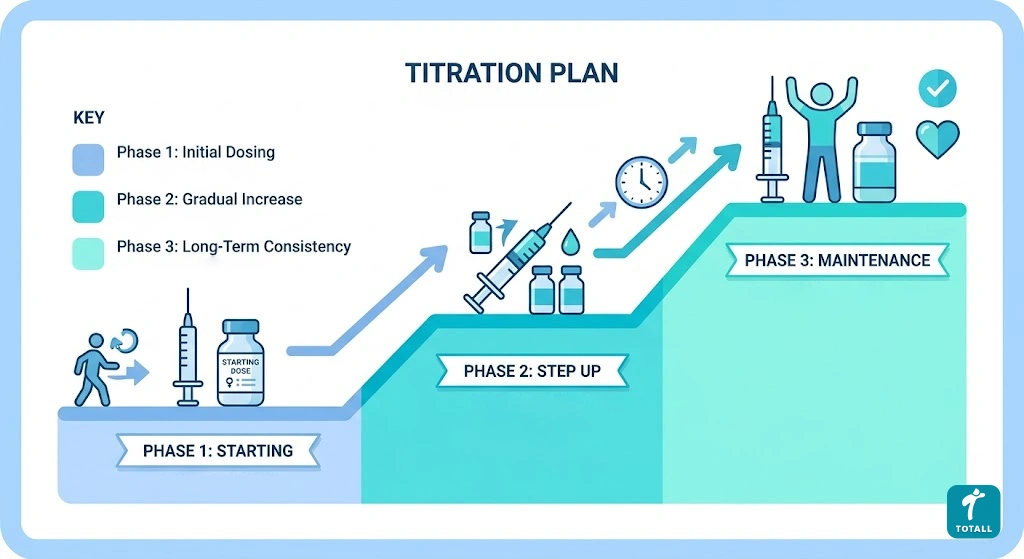
Without giving specific numbers, here’s the general shape most semaglutide titration schedules follow, so you know what to expect in conversation with your doctor:
- Starting phase. Treatment begins at the lowest available dose, mainly to let the body adjust rather than to produce a noticeable clinical effect yet.
- Step-up phase. The dose is raised at intervals, commonly around every four weeks, moving through several increasing steps.
- Maintenance phase. Once an effective, well-tolerated dose is reached, most patients stay on that dose for the remainder of treatment, sometimes for years.
The exact doses at each step, and how many steps there are, differ between brands and between the diabetes and weight-management indications. Your prescription label and your doctor’s instructions are the only accurate source for your specific schedule, not a generic online chart, which may reflect a different brand, indication or country’s approved dosing altogether.
4. Why Diabetes and Weight-Management Dosing Differ
Semaglutide for type 2 diabetes and semaglutide for weight management are often the same molecule from the same or a related manufacturer, but the approved dose ranges differ, sometimes significantly, because the two conditions have different clinical targets. Diabetes treatment is aiming for blood sugar control at a dose that balances effect with tolerability for long-term daily life. Weight-management treatment often goes to a higher maximum dose, since a stronger appetite-suppressing effect is part of the clinical goal, provided it’s tolerated.
This is exactly why using a diabetes-labelled product off-label at a weight-management dose, or vice versa, without your doctor’s specific guidance is not a safe substitution to make on your own, even if the active ingredient is technically the same.
5. How Your Doctor Decides When to Increase the Dose
A dose increase isn’t just a calendar date. Your doctor is generally weighing several things at each follow-up before deciding to move you up a step:
- Are gastrointestinal side effects from the current dose settled down, or still ongoing?
- Is blood sugar (for diabetes) or weight and appetite (for weight management) responding as expected at the current dose?
- Has enough time passed on the current dose for the body to fully adjust, generally a minimum of about four weeks?
- Are there any new symptoms, blood test changes, or other medicines introduced since the last visit that change the picture?
If side effects are still significant, many doctors will hold at the current dose for longer rather than increasing on schedule, since forcing an increase into ongoing nausea usually makes things worse, not better. This is a normal and expected adjustment, not a sign that something has gone wrong.
6. Signs the Dose Was Increased Too Quickly

If a dose increase has been too fast for your body, it usually shows up within the first week or two afterward as:
- Nausea that’s significantly worse than what you experienced on the previous dose, rather than a mild, settling adjustment
- Vomiting, especially repeated episodes
- Inability to keep food or fluids down, which can lead to dehydration
- Severe fatigue that goes beyond the mild tiredness some people notice with dose changes
If you experience any of these after a dose increase, contact your prescribing doctor. In many cases the answer is simply to stay at the previous dose for longer before trying again, rather than pushing through or stopping treatment altogether.
7. What Happens If You Plateau on a Dose
A plateau, where weight loss or blood sugar improvement slows down or stalls at a given dose, is common and doesn’t automatically mean the dose needs to increase. Your doctor will typically look at a few things first: whether you’ve actually reached the maintenance dose yet or are still mid-titration, whether diet and activity levels have shifted since starting treatment, and whether enough time has passed at the current dose to judge its full effect, since the body’s response to a given dose can take several weeks to fully show.
If those factors are accounted for and progress has genuinely stalled, moving to the next available dose step, if one exists and is clinically appropriate, is a reasonable next conversation to have with your doctor. It isn’t something to decide alone based on frustration with the pace of results.
8. Is There a Maximum Dose, and What Happens There
Yes, every approved semaglutide product has a defined maximum dose for its indication, beyond which going higher isn’t studied or approved, and doesn’t reliably produce better results, it mainly increases the risk of side effects without a matching benefit. If you reach the maximum dose for your product and indication and are still not seeing the response you and your doctor expected, the conversation shifts, toward reviewing diet and activity levels, ruling out other contributing factors, or in some cases discussing an alternative medicine such as tirzepatide, rather than simply trying to push the dose higher than what’s approved.
9. Why We Won’t Publish a Generic Chart

We get asked for a specific chart often enough that it’s worth explaining plainly why we’re not providing one. A chart pulled from the internet typically reflects one specific brand, one specific country’s approved labelling, and one specific indication, none of which may match your actual prescription. Using someone else’s chart, or a chart for a different brand or indication than what you’ve been prescribed, is a real and common way people end up on the wrong dose for their situation.
The genuinely useful version of a “dosage chart” is the one written specifically for your prescription, by your doctor, based on your bloodwork, your tolerance, and your treatment goal. That’s not something a website can responsibly replace, and any site that hands out a universal chart without that context is leaving out the part that actually matters.
10. Titration for the Tablet Form
The oral tablet form of semaglutide is titrated on a similar principle, a low starting dose held for several weeks before stepping up, but the specific doses and intervals differ from the injectable form and shouldn’t be assumed to match it. Because oral absorption is low and depends heavily on the strict empty-stomach timing rules, missing the food and water rules consistently can look like a titration or dosing problem when the real issue is administration technique. If you’re on the tablet and not seeing the expected response, reviewing how consistently the morning routine has been followed is often the first useful step before assuming the dose itself needs to change.
11. Frequently Asked Questions
How often does the semaglutide dose increase?
Most schedules increase the dose at intervals of around four weeks, though your doctor may hold at a given dose longer if side effects haven’t settled or your body needs more time to adjust.
What is the starting dose of semaglutide?
Every approved product has a labelled starting dose, which is always the lowest available strength, intended to let the body adjust rather than produce a full clinical effect immediately. The exact figure is specific to your brand and indication and should come from your prescription, not a general online source.
Can I increase my own semaglutide dose if I feel ready?
No. Dose increases should be decided by your prescribing doctor based on how you’re tolerating the current dose and your overall response, not on how ready or impatient you feel. Increasing early is one of the most common causes of severe nausea and vomiting.
What if I’ve been on the same dose for months with no results?
This is worth discussing with your doctor rather than adjusting the dose yourself. They’ll typically review whether you’ve reached an effective maintenance dose, whether diet and activity have shifted, and how long you’ve actually been at the current dose before deciding on next steps.
Is the maximum semaglutide dose the same for diabetes and weight management?
No, the approved maximum dose differs between the two indications, since they’re targeting different clinical outcomes at different levels of tolerability.
Why did my doctor keep me on the same dose longer than the standard schedule?
This usually means your body needed more time to adjust to gastrointestinal side effects before moving up. It’s a normal, common adjustment and not a deviation from proper care.
Can I follow a semaglutide dosage chart I found online?
We’d advise against it. Charts found online often reflect a different brand, country’s approved labelling, or indication than your own prescription, and following one that doesn’t match your situation is a real way to end up on an incorrect dose.
12. Conclusion
Semaglutide dosing is not complicated once you understand the logic behind it: start low, rise slowly, and let the pace be set by how your body actually responds rather than a fixed calendar. The specific numbers matter far less than getting that process right, and getting it right is what a doctor watching your bloodwork, your side effects and your progress over time is actually for.
For a full breakdown of how semaglutide works, side effects, brands and pricing, see our complete Semaglutide Guide. To get a dosing plan built around your own health profile, book a consultation with TOTALL’s diabetes and obesity specialists in Indore, or call +91 731 244 3344.