
Semaglutide Injection vs Tablets: The Complete Comparison Guide
Part of TOTALL’s complete Semaglutide Guide. Medically reviewed by the endocrine and obesity-medicine team at TOTALL Diabetes Hormone Institute, Indore. Last updated July 2026.
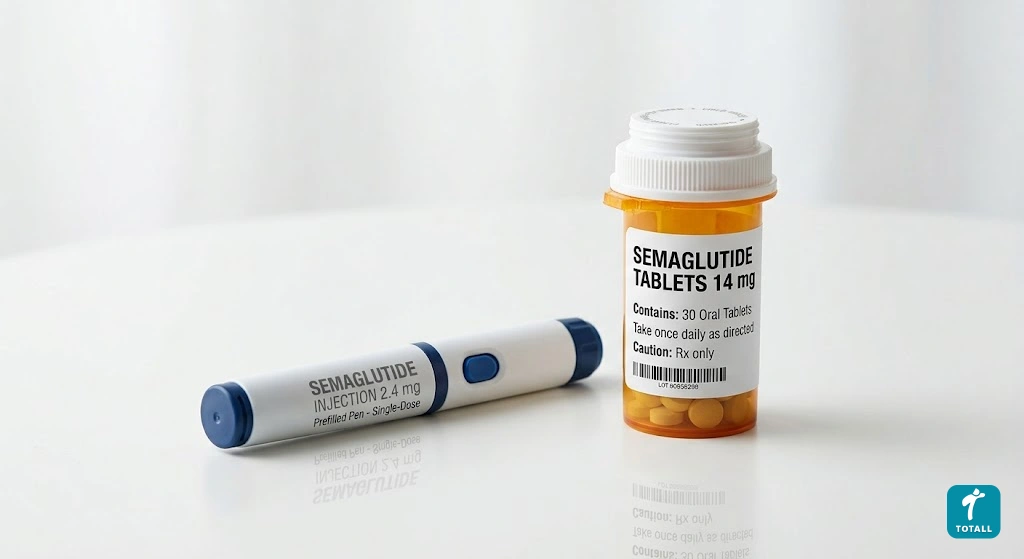
Semaglutide comes in two very different physical forms: a once-weekly injection and a once-daily tablet. Both deliver the same active molecule, but they behave differently in the body, come with different daily routines, and suit different kinds of patients. Our main Semaglutide Guide covers this briefly; this guide is the full, practical version, covering how the pen works, how to store both forms correctly, what to do about a missed dose, and the tablet-timing mistakes that quietly reduce how well it works.
Table of Contents
- 1. The Core Difference: Why Form Changes Absorption
- 2. Injection vs Tablet: Side-by-Side Comparison
- 3. Using the Semaglutide Injection Pen: What to Expect
- 4. Injection Sites and Rotation
- 5. Semaglutide Tablets: The Strict Timing Rules That Actually Matter
- 6. Storage: Fridge, Room Temperature and Travel
- 7. What to Do About a Missed Dose
- 8. Which Form Is Right for You?
- 9. Injection and Tablet Brands Available in India
- 10. Frequently Asked Questions
- 11. Conclusion
1. The Core Difference: Why Form Changes Absorption
Semaglutide is a peptide, a chain of amino acids. Peptides are broken down by digestive enzymes in the stomach and intestine, which is exactly what happens to the protein in the food you eat. An injection bypasses this entirely by delivering the drug directly under the skin, from where it’s absorbed almost completely into the bloodstream.
A tablet has to survive that same digestive environment that would normally destroy it. The oral form of semaglutide gets around this using an absorption enhancer called SNAC, which temporarily raises the local pH in a small area of the stomach lining and helps the drug pass through the stomach wall before it gets broken down. Even with this enhancer, oral absorption is low, generally around 1 percent of the tablet’s content actually reaches the bloodstream. That is why oral doses are measured in milligrams while injectable doses are measured in much smaller amounts, and it is also why the tablet’s timing rules are so strict. Any food, drink or other tablet in the stomach at the same time competes for that narrow absorption window and can reduce how much of the dose actually gets in.
2. Already Decided Which Form You’re Using?
If you’re still weighing which form to start with, our main Semaglutide Guide has a full side-by-side comparison of frequency, effectiveness and brand options. This article picks up from there and focuses entirely on the practical side that comparison table doesn’t cover: how to actually use the pen correctly, where to inject, how to store both forms, what to do if you miss a dose, and the tablet-timing habits that make or break how well it works.
3. Using the Semaglutide Injection Pen: What to Expect
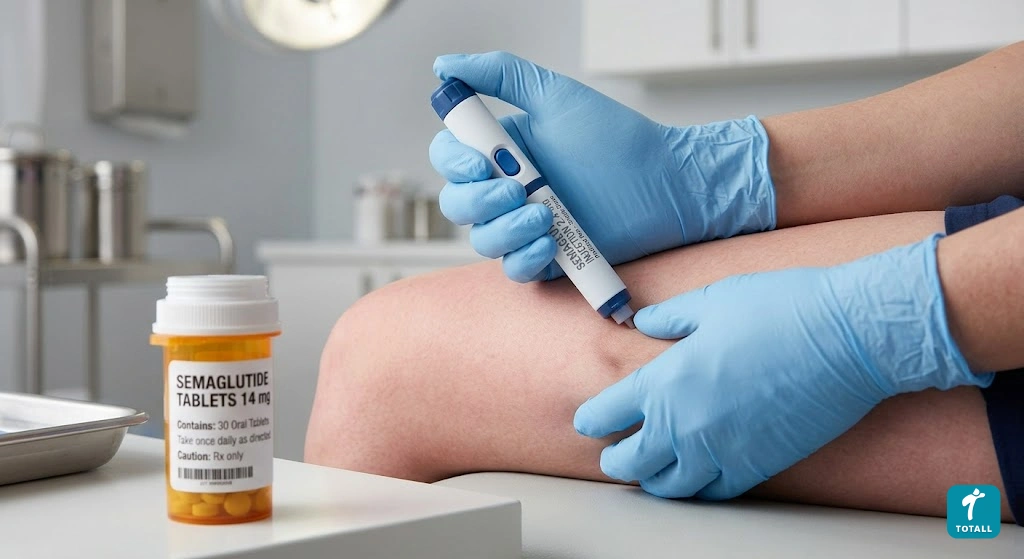
Most Indian brands supply semaglutide in a pre-filled pen that’s designed to be simple to use once you’ve been shown how, but the first few times genuinely benefit from in-person teaching rather than reading instructions alone. Your doctor or nurse will walk you through this at your first visit, and the general process looks like this:
- Remove the pen from the fridge and let it come to room temperature for a few minutes if your brand’s instructions recommend it.
- Attach a new needle just before use, and remove the outer and inner needle caps.
- Dial or select the correct dose exactly as prescribed. Pens are designed so the dose has to be set correctly before the injection can be given, which is a built-in safety feature.
- Pinch a fold of skin at the chosen injection site and insert the needle at the angle your nurse demonstrated, usually straight in for most pen designs.
- Press the injection button fully and hold for several seconds as instructed on your specific brand’s leaflet, to make sure the full dose is delivered.
- Remove the needle, dispose of it safely in a sharps container, and never reuse a needle.
Some brands use a reusable pen with replaceable cartridges, others are fully disposable after a set number of doses. Confirm which type you have been prescribed, since the handling instructions differ slightly between them.
4. Injection Sites and Rotation
Semaglutide injections are given subcutaneously, meaning into the fatty layer just under the skin, not into muscle. The three approved sites are the front of the thigh, the abdomen (avoiding a two-inch radius around the navel), and the back of the upper arm if someone else is giving the injection for you.
Rotating between sites, and between different spots within the same site, week to week reduces the chance of irritation, lumps, or a change in how consistently the drug is absorbed at any one spot. A simple habit many patients use is picking a different quadrant of the abdomen or a different thigh each week and keeping a mental or written note of the last injection point.
5. Semaglutide Tablets: The Strict Timing Rules That Actually Matter
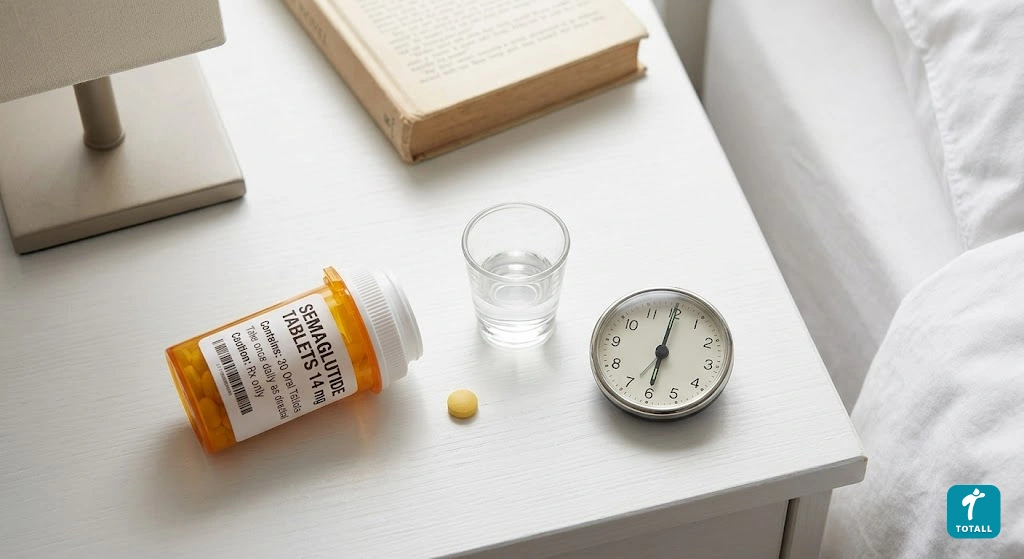
The oral tablet’s effectiveness depends almost entirely on how strictly the timing rules are followed, more so than with most other oral medicines. This is the single biggest reason people report the tablet “not working as well” compared to what they expected.
- Take it the moment you wake up, before tea, coffee, or anything else by mouth.
- Use no more than half a cup (about 120 ml) of plain water to swallow it. Any more water than this can dilute the local stomach environment the tablet depends on.
- Swallow the tablet whole. Splitting, crushing or chewing it changes how it’s absorbed and is not recommended.
- Wait at least 30 minutes before eating, drinking anything other than plain water, or taking any other oral medicine, including other tablets you may take every morning.
- Take it at roughly the same time every day, since the absorption enhancer works best on a consistent routine rather than a shifting one.
People who take their morning medicines together, coffee first, or breakfast shortly after waking often find the tablet timing genuinely inconvenient to build into an existing routine. That inconvenience is a legitimate reason to discuss the injectable form instead with your doctor, rather than following the tablet rules loosely and getting a reduced effect without realising why.
6. Storage: Fridge, Room Temperature and Travel
Semaglutide injection pens and vials are temperature-sensitive protein-based products. Unopened pens generally need to be stored refrigerated at 2 to 8 degrees Celsius, and must never be frozen; a pen that has frozen should not be used even if it looks normal. Once a pen is in use, most brands allow it to be kept at room temperature (generally up to 30 degrees Celsius) for a limited number of weeks, specific to that product’s leaflet, which is what makes weekly use practical without needing a fridge on hand every single time.
For travel, an insulated pen case or a small cool bag with an ice pack (not direct contact with ice) is the standard approach for longer trips, and airlines generally allow prescription injectable medicine with supporting documentation in carry-on baggage. Tablets are far simpler for travel since they’re stored at room temperature in their original packaging away from moisture, with no cold-chain requirement at all.
Always check the specific storage instructions printed on your brand’s leaflet, since allowed in-use periods and temperature ranges vary slightly between manufacturers.
7. What to Do About a Missed Dose
Both forms have general guidance for a missed dose, though the exact permitted window can vary slightly by brand, so always check your specific product’s leaflet or ask your pharmacist.
Missed injection: If you remember within a few days of the missed dose (commonly up to 5 days, depending on the brand), take it as soon as you remember, then continue your original weekly schedule from your next planned date. If it’s been longer than that window, most guidance is to skip the missed dose entirely and simply take the next dose on your regular scheduled day, rather than doubling up.
Missed tablet: If you miss a morning dose, skip it for that day and take your next tablet the following morning at the usual time, on an empty stomach as usual. Do not take two tablets in one day to make up for a missed one.
Never double a dose to compensate for a missed one, for either form. If you’re unsure which guidance applies to your specific brand, a quick call to your pharmacist or doctor is the safest step rather than guessing.
8. Which Form Is Right for You?
There isn’t a universally correct answer, but a few practical patterns tend to guide the decision in real consultations:
- If you travel frequently, especially without reliable refrigeration, or you strongly prefer to avoid needles, the tablet’s lack of cold-chain dependency and needle-free routine is a genuine advantage, provided you can commit to the strict morning rules.
- If your mornings are already busy or unpredictable, or you take other morning medicines that would be disrupted by a 30-minute waiting rule, the injection removes that daily friction entirely and only asks for your attention once a week.
- If you’ve struggled with adherence to daily medicines in the past, the once-weekly injection schedule is generally easier to maintain consistently than a daily tablet with strict conditions attached.
- If needle anxiety is a significant barrier for you personally, that’s a legitimate factor your doctor can weigh, since a tablet taken consistently will outperform an injection that gets delayed or skipped out of avoidance.
This decision is genuinely worth discussing directly with your doctor, since your specific diagnosis, other medicines and daily routine all affect which form gives you the best real-world result, not just the better result on paper. Book a consultation with TOTALL’s diabetes and obesity specialists to talk through which form fits your life.
9. Which Brands Come in Which Form
Only a few Indian brands currently offer both forms. Torrent’s Sembolic and Semalix are available as both injection and tablet. Novo Nordisk’s Rybelsus remains the main dedicated oral option alongside newer domestic oral brands entering the market. Every other major Indian brand, including Noveltreat, Sematrinity, Obeda, Semaglyn and Semasize, is injection-only for now.
For the full brand list with current indicative pricing, see the brands and pricing section of our main Semaglutide Guide, or check live stock and pricing directly with TOTALL Pharmacy.
10. Frequently Asked Questions
Why does the semaglutide tablet dose look so much higher than the injection dose on the packaging?
Because only around 1 percent of an oral dose actually gets absorbed, tablets need a far larger printed milligram amount to deliver a similar effect to a much smaller injectable dose. The two numbers aren’t measuring the same thing, so don’t compare them directly, or assume a higher-numbered tablet is a stronger treatment than a lower-numbered injection.
Can I switch from the injection to the tablet, or the other way around?
Yes, this is a common and reasonable switch to discuss with your doctor, but it requires a proper dose recalculation rather than simply matching numbers, since the two forms behave so differently once absorbed.
Does the semaglutide pen hurt?
Most patients describe it as a brief pinch rather than significant pain, since the needles used are short and fine. Discomfort is usually more related to injection site irritation from not rotating sites than to the injection itself.
What happens if I eat before waiting 30 minutes after the tablet?
Eating or drinking too soon reduces how much of the dose is actually absorbed, which can make the tablet less effective that day. It isn’t dangerous, but it does reduce the value of that day’s dose.
Can I take semaglutide tablets with my morning coffee?
No. Coffee, tea and any other drink besides plain water should wait until at least 30 minutes after taking the tablet, since anything else in the stomach interferes with absorption.
Do I need to refrigerate semaglutide tablets?
No, tablets are stored at room temperature away from moisture, unlike the injection, which needs refrigeration before first use.
What should I do if my semaglutide pen has been left out of the fridge too long?
Check your specific brand’s leaflet for the allowed in-use, room-temperature period, since this varies by product. If you’re unsure whether a pen is still good to use, contact your pharmacist rather than guessing.
11. Conclusion
The injection and the tablet are the same active drug wearing two very different routines. The injection asks for a needle once a week and very little daily thought. The tablet asks for no needle at all, but a strict morning ritual every single day. Neither is automatically the better choice, the right one is the one that actually fits into your life consistently, since consistency is what determines whether either form works well in practice.
For a full breakdown of how semaglutide works, dosage, side effects, brands and pricing, see our complete Semaglutide Guide. To find out which form is right for you, book a consultation with TOTALL’s diabetes and obesity specialists in Indore, or call +91 731 244 3344.